What is the Dalyan blue crab?
It is Callinectes sapidus, the Atlantic blue crab, and it is not native to the Mediterranean. The species belongs to the western Atlantic, from Nova Scotia down to Argentina. It turned up in Mediterranean waters in the 1930s, has been in Turkish waters ever since, and in the Köyceğiz–Dalyan lagoon it now supports a working commercial fishery.
You will recognise it on ice by two things: the colour and the back legs. The shell is olive to grey-brown, the legs and claws are blue, and the rearmost pair of legs is flattened into paddles. This is a swimming crab, not a scuttling one, which is a large part of why it spread so far so fast. A good eating crab measures 13 to 15 cm across the shell from point to point; the biggest reach around 20 cm.
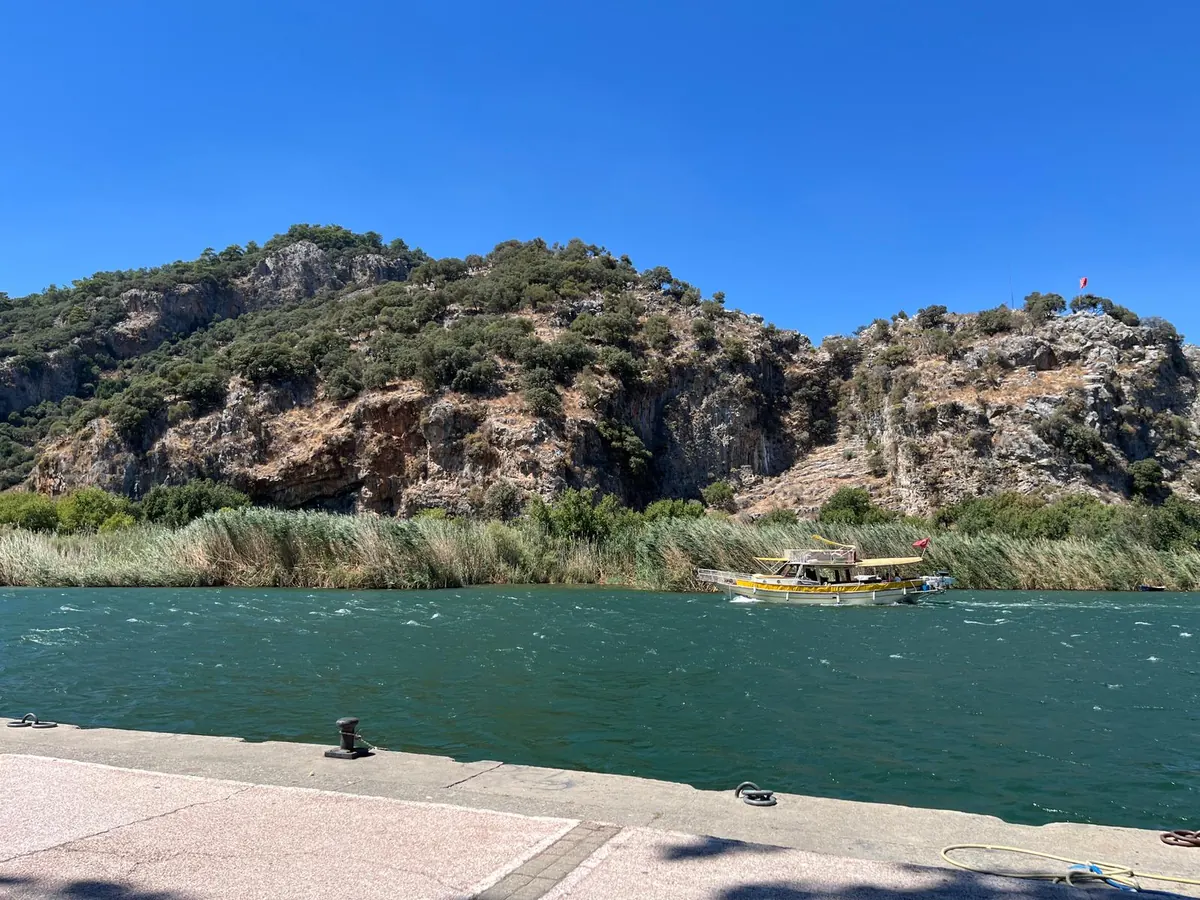
The reason it thrives here is the water. Blue crab tolerates everything from fresh water to full-strength sea water, and the Dalyan channel is exactly that range in five kilometres: Köyceğiz Lake at the top, reed beds and brackish channels in the middle, the open Mediterranean at İztuzu at the bottom. Females move down towards the salt to spawn and the young drift back up. From a crab’s point of view the lagoon is close to ideal.
How did an invasive species become the local speciality?
Because selling it turned out to be more realistic than fighting it. Blue crab arrived as a problem rather than a delicacy: it cuts through nets, and it eats fish that are already caught and cannot swim away from it.
That lands harder here than it would elsewhere. "Dalyan" means fishing weir, the wooden weirs still cross the channel below the town, and the crab went straight for the thing the town is named after. Fishermen were handed a species that damaged their gear, ate their catch and had no local market at all.
The market arrived later — Turkish cities, then export — and the town did what fishing towns do and started landing the crab on purpose. It is now on almost every menu along the river front, and it has quietly become the dish visitors associate with Dalyan.
One thing worth saying plainly, because menus sometimes imply otherwise: eating an invasive species is not conservation. Nobody is going to eat Callinectes sapidus back out of the Mediterranean. The honest version is more modest — the crab is abundant, it is caught a few hundred metres from where you are sitting, and you are not eating something scarce.
Where to eat blue crab in Dalyan
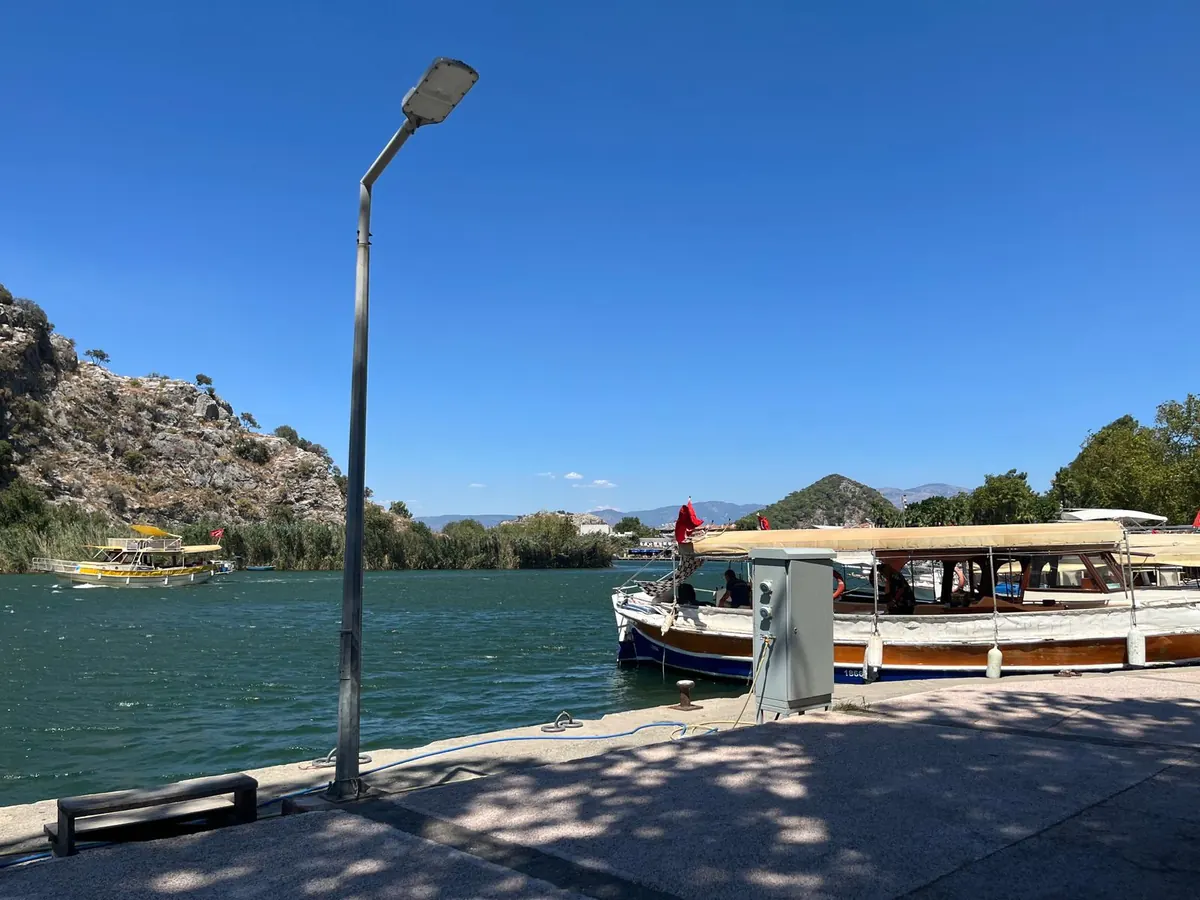
On the river front, in the fish restaurants whose terraces are built out over the water — and, if you are on a boat, at a handful of places down the channel that road traffic cannot reach at all.
We do not publish restaurant names on this site. A name we push today changes hands next season, and you would then be eating on our word rather than on the evidence in front of you. What we can give you is the test we use ourselves, which takes about ninety seconds at the door.
Timing helps as much as choosing. Go at early evening and you get the crab and the best light of the day together: the rock tombs opposite the town were cut into the cliff in the 4th century BC, they face west, and for roughly forty minutes before sunset they run from grey through honey to orange. After dark they are floodlit. The view does half the work and the crab does the rest.
- Ask whether the crab is from this lagoon. Blue crab is landed all over Türkiye now — the Çukurova delta, Bafa, the Aegean gulfs. Local is not automatically better, but a kitchen that knows the answer is a kitchen that knows its supplier.
- Ask to see it before it is cooked. A whole crab should be intact, feel heavy for its size and smell of clean sea water. If the answer is that it comes pre-picked and frozen, that is a perfectly fair answer — you just want it before you order rather than after.
- Crab and fish are sold by weight here, which is normal. Ask the price per kilo and ask them to weigh it in front of you. Honest kitchens do this without blinking; hesitation tells you what you need to know.
- A short menu in Turkish and a waiter who tells you what came in this morning beats a photo menu in six languages. Not always. Usually.
- Bread and water carry a small charge. That is the local convention, not a scam.
- Bring cash in lira as a backup. Cards work in most restaurants, but not in every small kitchen down the channel.
Can you eat blue crab on a boat trip?
Yes, in two different ways: at a riverside restaurant the boat pulls into, or — on a private charter — cooked and eaten on board. What matters in both cases is that it is arranged before you sail.
On the standard shared trip the day runs from about 09:30 to 17:30, with lunch either at the İztuzu beach café or at a fish restaurant on the water. If you want crab at that stop, it has to be asked for in advance. A blue crab is not a portion sitting in a fridge waiting for you; it is a live or freshly boiled animal that somebody has to have on hand at one o’clock for a boat that will not wait.
A blue crab tasting boat trip is therefore not a product you buy off a shelf in Dalyan. It is something we set up with the boat and the kitchen beforehand, and what is possible depends on the boat: some have a galley and crew who cook, some carry a cool box, ice and water and nothing more. Tell us at the booking stage and we will tell you which boats can genuinely do it, rather than promising a menu and working it out on the day.
There is a real case for eating crab afloat rather than at a table. You are already in a swimsuit, your hands are already wet, and you can rinse garlic butter off over the side. It is the least formal way to eat the least formal food in this town.
How is blue crab cooked in Dalyan?
Four ways, and they ask progressively less of you: boiled whole, grilled over charcoal, cracked into a garlic-butter or tomato sauce, or picked out of the shell into a meze or soup.
The sauce version is the one most visitors are served and the one to be mildly careful with. Butter, garlic and tomato are extremely good at flattering a crab that has been frozen too long. That is not a reason to avoid it — it is the easiest and often the most enjoyable way to eat one — it is a reason to ask what you are getting before the sauce arrives.
- Boiled whole. Eight to twelve minutes in well-salted water for a crab this size; much longer and the meat turns stringy. Served with lemon and nothing else, which is also the version that shows you exactly what you were sold.
- Grilled. Split, cleaned and laid over charcoal with butter and garlic. The shell chars, the meat picks up smoke, and this is the best of the four if the kitchen has a proper grill rather than a hotplate.
- Cracked into a sauce. Garlic and butter, or tomato and chilli, sometimes finished with a splash of rakı. The shells are cracked before cooking so the sauce gets inside the chambers.
- Picked, as meze or soup. Meat only, no work, no shell on the tablecloth. Good — but you lose the half hour of dismantling something with your hands, which for a lot of people is the point.
How do you actually eat a blue crab?
Twist off the legs, lever off the apron, lift the top shell away, scrape out the gills, snap the body in two and work the meat out of the chambers. About fifteen minutes a crab once you find the rhythm, and considerably longer for your first one.
Tools worth asking for at the start: a cracker or a heavy knife, a small fork or pick, an empty bowl for shells, and a finger bowl with lemon in it. Any kitchen that serves crab whole will have all four, and most will bring them without being asked.
- Twist off the walking legs and the two paddle legs. There is decent meat in the paddles; the thin walking legs are mostly for sucking on while you decide what to do next.
- Turn the crab over. The apron is the flap on the underside — narrow and pointed on a male, wide and domed on a mature female. Lever it up with a fork and pull it away.
- Hold the body and lift the top shell off from the back end. It comes away in one piece.
- Scrape out the feathery grey gills down both sides. They are known as dead man’s fingers, they are inedible, and they are not poisonous — just discard them. The yellow-brown paste in the middle is the hepatopancreas; some people eat it happily, and if you are unsure, leave it.
- Rinse the body if there is a bowl, then snap it down the middle. Each half is a honeycomb of chambers with a lump of white meat in each one. A small fork or the tip of a knife gets it out.
- Crack the claws with a nutcracker or the back of a heavy knife — one firm tap, not a hammer blow, or you spend the next ten minutes picking shell splinters out of the meat.
- Ask for extra napkins before you begin. You will need more than they bring.
How to tell a good crab from a poor one
Weight, not width. A crab that feels heavy for its size is full of meat; a light one has moulted recently and will be watery and thin however well it is cooked.
Crabs grow by shedding the whole shell and building a bigger one, and for a while afterwards the new shell is soft and the body is largely water. A "papershell" — hard but light, slightly translucent at the edges — is the one to hand back. In early summer you may also be offered soft-shell crab deliberately, which is a different dish altogether: the whole animal is floured, fried and eaten shell and all.
Two more checks take a second each. A live crab should react when it is picked up. A cooked one should smell of clean sea water and nothing else — any hint of ammonia means it was dead too long before it went into the pot.
Set your expectations on yield as well. A whole blue crab returns roughly one part meat to seven parts crab by weight, which is why it is sold by the kilo, eaten slowly, and works far better as a shared plate in the middle of the table than as one person’s main course. Order it as the thing the evening is built around rather than the thing you eat before something else.
Egg-carrying females — you can see the orange-brown sponge under the apron — belong back in the water, and a kitchen worth eating in will tell you the same thing without being prompted.
When is blue crab season in Dalyan?
Roughly May to October, with the best eating from June through to mid-autumn. Blue crab is a warm-water animal: it slows down below about 15°C and buries itself in the mud through the cold months, so winter catches are small even where it is fished hard.
The lagoon sits in the mid-twenties from June to September, which is when the crabs are moving, feeding and full. That happens to line up neatly with the boats, which run in Dalyan from April to the end of October.
If you want one month, we would say September: the sea is still warm, the crabs are at their heaviest, and the town has stopped being over 35°C the way it regularly is in July and August. May, June and early October are close behind. From November to March most riverside kitchens are shut and the question does not arise.
Should you order it? An honest answer
Order it if you are happy to work for your dinner, and skip it without embarrassment if you are not. A whole blue crab is forty minutes of cracking, picking and sucking meat out of leg joints, and at the end of it you have eaten a starter’s worth of protein.
Some people find that the best evening of the holiday. Others find it an ordeal conducted under a paper bib. Both reactions are reasonable and we have watched both happen at the same table on the same night.
If you want the flavour without the labour, the sauce version or a picked-crab meze gives you most of it and none of the shell. If you are eating before an evening boat or an early transfer, order the grilled sea bass and come back to the crab on a night with nothing after it.
One serious note. Crustacean allergy is common and can be severe, and it is not the same thing as a fish allergy. If it applies to anyone in your group, say so before you order anything at all rather than when the crab arrives — a small fish kitchen uses one grill, one set of pans and one pair of hands. Restaurants here take it seriously when they are told, and cannot when they are not.
Finally, wear something you do not mind. Garlic butter travels, and it travels furthest across a white shirt.