What exactly is a Dalyan boat trip?
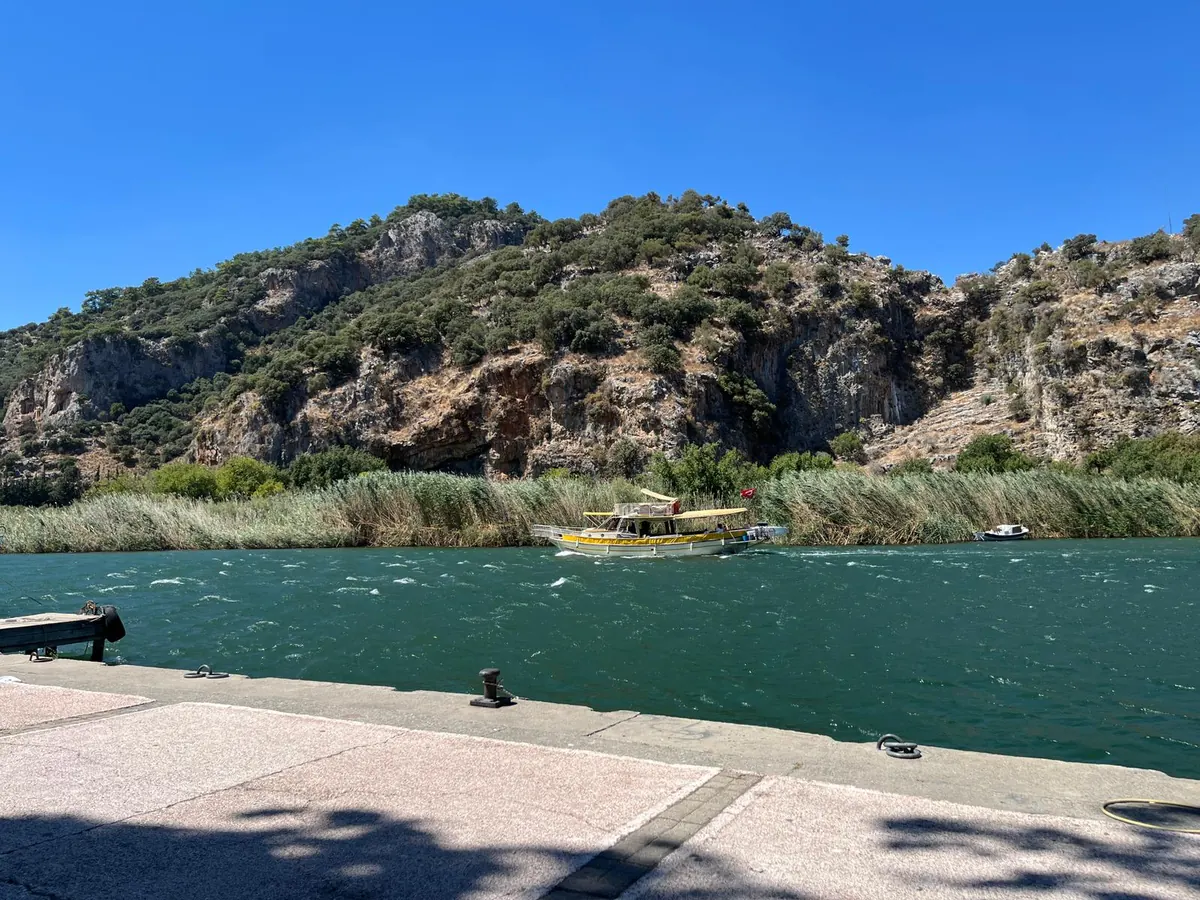
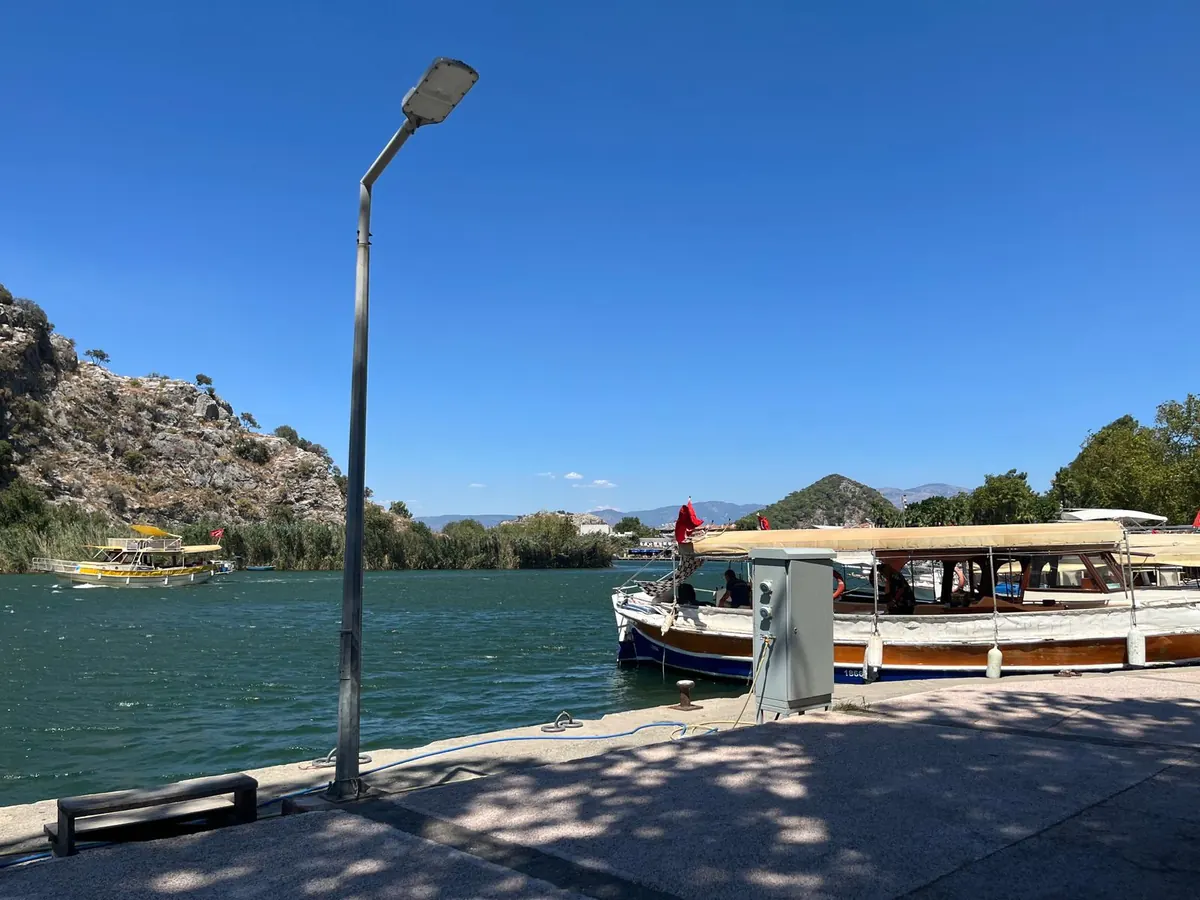
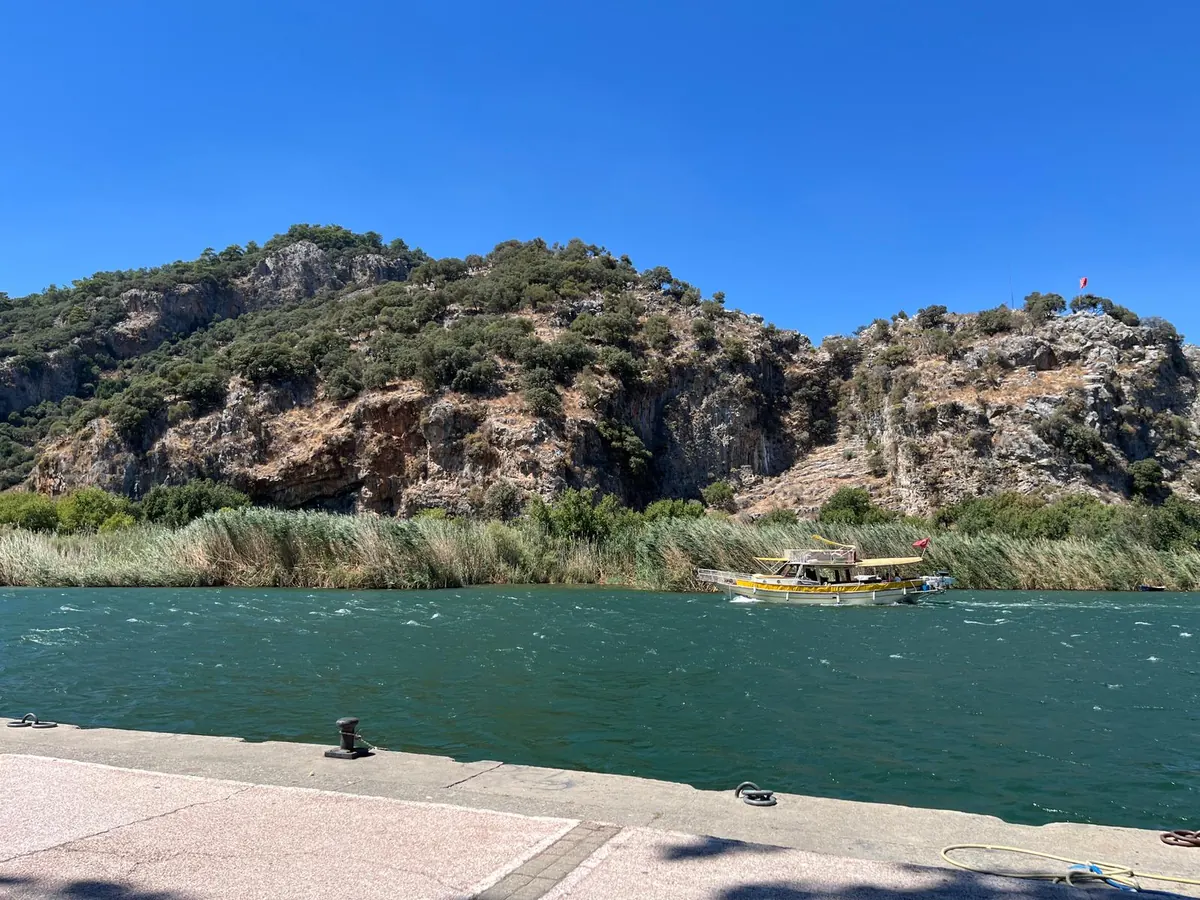
A Dalyan boat trip is a full-day river cruise that leaves the town quay and links four stops on one waterway: the reed labyrinth of the delta, the thermal mud pools at Sultaniye, the Kaunos rock tombs and İztuzu Beach at the river mouth.
The trip exists in this shape because of geography, not marketing. The Dalyan Çayı leaves Köyceğiz Lake, winds through about five kilometres of reed beds and reaches the Mediterranean at İztuzu. Everything the area is known for sits on that one line of water.
It matters that Dalyan has no beach of its own: to reach sand you get on a boat, which is why the jetty is busier at nine in the morning than the main road.
The whole delta is a Specially Protected Area — no jet skis, no speedboats, no beachfront building — so the trip is slower and quieter than people expect.
What does the standard route cover, stop by stop?
The classic shared trip runs from about 09:30 to about 17:30 and makes four stops, with the beach taking up the whole afternoon.
Times shift by twenty minutes depending on the boat, but the order is fixed: the beach is at the far end of the river.
- 09:30 — Departure from the Dalyan town quay. The first twenty minutes are the reed channels.
- 10:15 — Sultaniye hot springs and mud baths, on the far shore of Köyceğiz Lake. Allow an hour.
- 11:45 — A slow crossing of the open lake with the Taurus mountains behind it. Tea is served on board.
- 13:00 — The Kaunos rock tombs, viewed from the water, with an optional landing at the ancient city.
- 14:00 — İztuzu Beach. Three to four hours: swim, walk, eat, visit the turtle rescue centre.
- 17:30 — Back up the river to Dalyan, usually with the light going gold on the tombs.
Why the reed channels are the part nobody expects
The first twenty minutes out of Dalyan are the section that appears in nobody’s research and everybody’s photographs: reeds three metres tall on both sides, a channel that narrows until the boat almost brushes them, and herons lifting off ahead of the bow.
The delta is a maze: channels split, rejoin and dead-end, and skippers navigate from memory rather than markers. From inside the reeds you cannot see the town, the cliff or the sea — only green walls and sky.
You will pass the wooden fish weirs that give the town its name. Dalyan means "fishing weir", the traps still cross the channel, and mullet and sea bass run through them between the lake and the sea.
What are the Kaunos rock tombs, and can you get close?
The tombs are temple façades — columns, pediments, the full architecture — cut directly into the cliff in the 4th century BC, and no, you cannot climb up to them. The boat holds position underneath, and that is as close as anyone gets.
They belong to Kaunos, a Carian city that borrowed the Lycian tomb style from its neighbours to the east, which is why they look like small Greek temples halfway up a rock wall in a place with no other classical architecture in sight.
The cliff faces west, so the stone shifts from flat grey at midday to honey in the late afternoon and orange for about forty minutes before sunset. Day boats pass at around one o’clock, the least flattering light there is. If the photograph matters, look again from the town side in the evening.
The ancient city is a separate visit and worth it: a theatre cut into the hillside, an acropolis looking down the delta, Roman baths and the harbour agora. That harbour silted up, which is how Kaunos died and how the reed beds were born. Some trips offer an optional landing; otherwise take the small ferry across the river and walk ten minutes. Go early or late — there is almost no shade.
How do the Sultaniye mud baths actually work?
You coat yourself in grey sulphur mud from the pool, stand in the sun until it dries and cracks, rinse it off in the wash pool, then sit in the thermal water at around 39°C. Allow an hour for the whole sequence.
Sultaniye sits on the far shore of Köyceğiz Lake and has been used since antiquity. It is undignified, and it is reliably the part of the holiday people talk about afterwards.
Two warnings from experience rather than a brochure: the sulphur smell gets into swimwear and does not come out, so wear an old costume, and the mud blackens silver, so leave rings and chains on the boat.
The boat takes you there and waits, but Sultaniye charges its own entrance at the gate in Turkish lira, and on almost every shared trip that is excluded from the fare. Ask your agency for the current amount before you leave so you carry the right notes.
How long do you get at İztuzu Turtle Beach?
Three to four hours on a properly run trip, which is the right amount — İztuzu is four and a half kilometres of sand sealing the river off from the open Mediterranean, and it takes an hour just to walk one length of it.
The beach has been protected since 1988, when an international campaign stopped a hotel being built on it. Loggerhead turtles nest here between May and September, and in those months the sand closes at night, umbrellas stay behind a marked line and no vehicles go on it. Those rules are the entire reason the beach still looks the way it does.
You will not see nesting or hatching — both happen after dark, when nobody is permitted on the beach. You can see rescued loggerheads at the DEKAMER rehabilitation centre at the river end, beside the café, showers and sunbeds.
Use the beach hours as a filter when comparing trips: a boat promising the mud baths, Kaunos, the lake and the beach in five hours is quietly giving you forty minutes of sand.
Shared boat or private charter: which should you book?
A shared boat leaves at a fixed time on a fixed route and costs the least per person; a private boat leaves when your group is ready and goes where you ask. That is the whole difference, and it is bigger in practice than it sounds.
Boats working the delta carry from about six to about thirty passengers. On a shared trip you are on somebody else’s timetable: the 09:30 departure goes whether the toddler has finished breakfast or not, and the beach hours are the skipper’s.
Private hire is not automatically the expensive option. Per person the two converge quickly — once a group reaches six or seven, hiring the whole boat is often close to the same money per head and a completely different day. Below four people, shared is clearly cheaper.
Private also unlocks what the shared route cannot do: an early start so İztuzu is nearly empty, a late finish under the tombs at sunset, or skipping the mud baths because half the group does not fancy them. Shared suits couples and small groups happy with a timetable; private suits families with small children and groups of six or more.
What does a Dalyan boat trip cost, and what is included?
There is no single fixed Dalyan boat trip price — it moves with the season, the boat, the size of your group and whether you buy a seat or the whole vessel — so any site quoting one number for the whole year is guessing. What stays consistent is the structure of what you pay for.
A shared day-trip fare normally covers the licensed boat and skipper, every transfer on the route, tea and water on board, and pick-up from your hotel or villa inside Dalyan. Normally excluded and paid in cash on the day: the Sultaniye mud bath entrance, the Kaunos site entrance if you take the optional landing, lunch, and sunbed hire at İztuzu.
Bring Turkish lira for that reason. Cards work in town, but boat cooperatives, site gates, the mud baths and the beach café want notes — and there are ATMs in Dalyan, none at İztuzu.
Private charter is priced per boat, quoted as half day (roughly four hours) or full day (roughly eight), with fuel, harbour fees and the skipper inside that figure. When you ask for a quote, give your dates and group size and ask which entrance fees sit outside the number — that one question removes most of the surprises people report.
What time do boats leave, and what changes through the season?
Shared boats leave the town quay at about 09:30 daily from April to October and are back around 17:30. What changes month to month is not the route but the heat, the sea temperature and how full the boat is.
May, June, September and early October are the best weeks on the water: warm sea, bearable air, everything open, boats that are not packed.
July and August run hot — regularly above 35°C — and the delta holds the heat. Every boat still goes, everything is busier, and you will organise the day around shade. All boats have a covered section; if somebody must stay out of the sun, say so when you book.
April and late October are a gamble that often pays off: green hills, cool evenings, a bracing rather than warm sea, and some boats not yet open or already closed. From November to March, most tourist boats are not running.
On timing: in May, June and September you can usually walk down to the quay and get on a boat. In July and August, and for any private charter in any month, book ahead. And do not put this trip on your arrival day — eight hours of strong sun after a flight is a poor start.
Who the trip suits — and who it does not
The river trip suits families, older visitors and anyone who is uneasy on open water, because the delta is flat, the boats have shade and rails, and İztuzu shelves gently on the river side. It suits you less if you came looking for deep turquoise sea.
Dalyan is a river town and rivers are green. If the picture in your head is clear blue water over white rock with pine down to the shore, that is Fethiye Gulf, about an hour up the road, and the 12 Islands day is the trip that delivers it. Plenty of people do both in one week.
Mobility is the other honest caveat: boarding at a jetty and the steps into the mud pool are the awkward moments, not the cruising. If somebody uses a stick or a wheelchair, say so when you book rather than on the morning — some boats are far easier to board than others.
What to bring on the boat
Pack for a day in which you will get wet three times and sit in direct sun for eight hours, with no shops between the jetty and the beach café. The most common mistake is sun cream: the breeze on a moving boat hides how strong the sun is, and burns here happen on decks far more often than on beaches.
- An old swimsuit for the mud — the sulphur smell will not wash out
- Towel and a full change of clothes
- High-factor sun cream, applied before you board and again after each stop
- Hat and sunglasses
- Cash in Turkish lira for entrance fees, lunch and sunbeds
- Water shoes if you have them — useful at the mud pool and on the lake shore
- A dry bag or a sealed plastic bag for phone and wallet
- Mosquito repellent if you are staying out on the river into the evening
- A light layer for the return leg — the delta cools quickly once the sun drops