The four ways people book a Dalyan boat trip
Strip away the branding and there are four routes to the same boats:
- Walking down to the quay and booking with whoever is standing by the boats.
- Booking through your hotel’s excursion desk or a rep who visits the hotel.
- Booking through an online marketplace or a reseller before you travel.
- Booking direct with someone who lives and works in Dalyan.
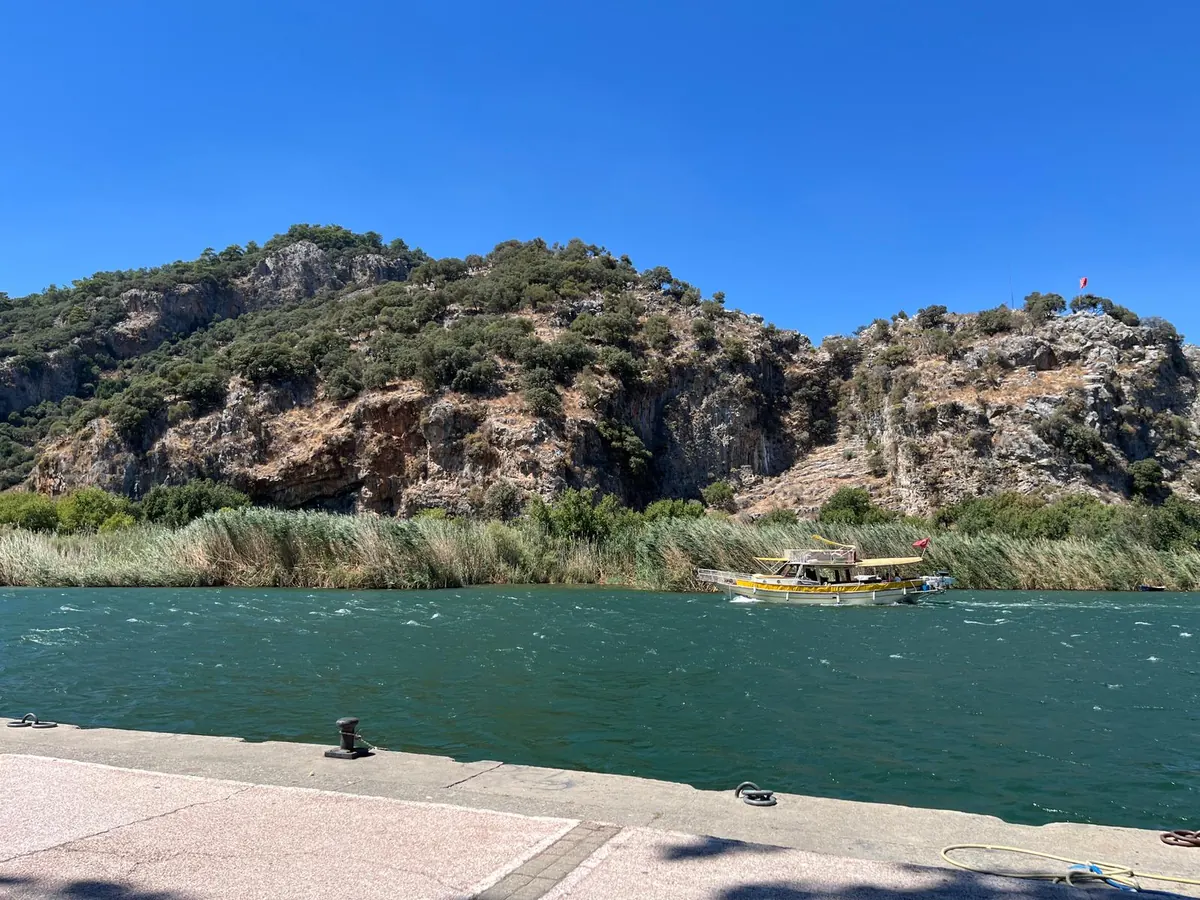
The important thing to understand is that these are not four different products. In a town this size, most routes lead to the same fleet of wooden day boats doing the same run: reed channels, mud baths, the Kaunos tombs, İztuzu. What differs is the chain between you and the boat, and every link in that chain has to be paid for and has to be reachable when something changes.
So the useful question is not which one is cheapest. It is which one gives you a clear answer to “what exactly am I getting, and who do I call at eight in the morning if it is blowing a gale.”
Booking at the quay: what it is genuinely good at
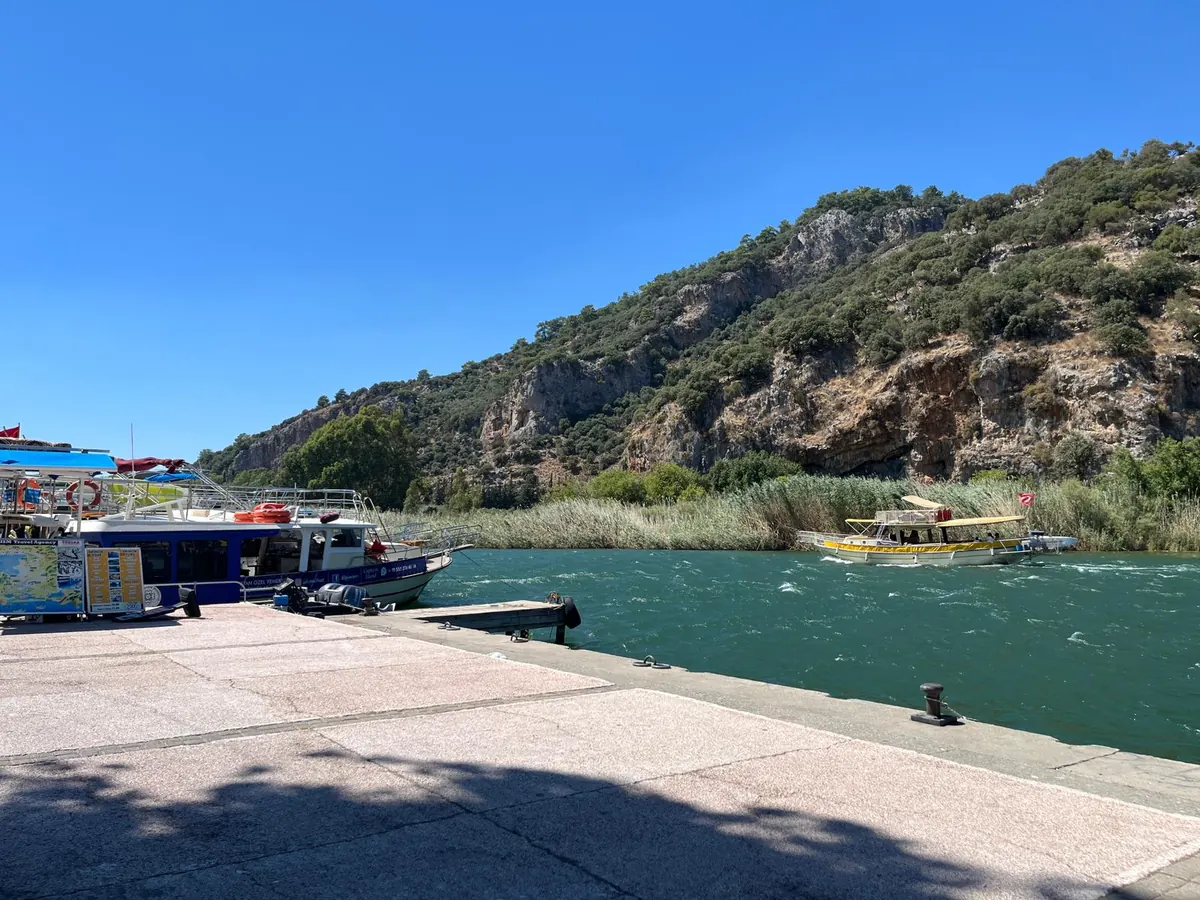
Walking along the Dalyan waterfront and booking from a board on a jetty is the oldest way to do this, and it has two real advantages that no other route can match.
First, you see the boat. Not a photograph of a boat — the actual vessel you will spend eight hours on, with its actual amount of shade and its actual condition. If shade or space matters to your group, that is worth a lot.
Second, you can read the room. You can see how full tomorrow looks, ask the person in front of you a direct question, and walk away if the answer is vague.
The weaknesses are equally real. You are booking on the day or the day before, which in July and August is exactly when there is least left to choose from. Terms are usually verbal, so if something is disputed later there is nothing to point at. And you are negotiating in a second language on a busy jetty, which is not where anyone makes their most careful decisions. If you do book this way, ask for the details in writing — even a message on your phone is better than a handshake.
The hotel desk or the excursion rep
This is how a large share of visitors to Dalyan book, and it is popular for a straightforward reason: it is the path of least resistance. Someone is already in your hotel, they speak your language, they will put you on a list, and often they will arrange the transfer from the door.
For a first visit to Türkiye with no Turkish and no local contacts, that convenience is worth something honest. It is not a trick. Pick-up from reception is a genuine service, and a desk with a person behind it all week is easy to go back to.
What you should know is that a desk or a rep is a reseller. They are not the boat. They sell a slot on someone else’s vessel, and everyone in that chain is paid out of what you hand over. That is normal commerce, not a scandal, but it has two practical effects: the desk usually sells the trips it has arrangements for rather than the one that best fits your group, and when you ask a specific question about the boat, the answer has to travel down the chain and back.
If you book this way, the useful move is to ask for the operator’s name and get the inclusions written down. A desk that gives you both is a good desk.
Online marketplaces and resellers
Booking before you travel, from home, on a platform with reviews and a refund policy, solves the two things people are most anxious about: certainty and recourse. Your date is held, your card is protected by the platform, and if it all goes wrong there is a formal complaints process. For nervous first-time travellers that is genuinely valuable.
The costs are less visible. Listings are written to be sold across many destinations, so the description is often generic — “traditional boat, mud baths, turtle beach” — and the specific things that decide your day are missing. Which jetty. How many people on board. Whether lunch is on the boat or at the beach. What happens to the entrance fees.
The other cost is distance. When a platform booking goes sideways at eight in the morning, you are messaging a support queue in another country about a boat in Dalyan. The queue cannot see the weather, cannot call the skipper, and cannot move you to Thursday.
None of this makes online booking wrong. If your dates are inflexible and you want the certainty, book online and enjoy the trip. Just read the inclusions properly first, and note who you would actually contact on the day.
Booking direct with someone in Dalyan
The fourth route is messaging a local operator yourself. It is what this site does, so treat the next few lines as an interested party describing their own model — and check the claims against the comparison above.
What direct booking gives you is a short chain and a named person. You describe your group — how many, what ages, what you actually want out of the day — and you get a recommendation that can include “do not book the full day, take the beach boat instead.” A reseller has no reason to say that. Someone whose reputation is local, and who may well see you in town afterwards, has every reason to.
It also means questions get answered rather than relayed. Whether the boat has a toilet, whether there are child-sized life jackets, whether the group ahead of you booked out the shaded seats — these are answerable in a message, before you commit, not discovered on the jetty. Asking commits you to nothing.
The honest limitation of direct booking is that you are trusting a person rather than a platform’s dispute process. That is exactly why the terms should be in writing before you pay, which is the subject of the next two sections — and why the whole of our booking terms is on the site to be read rather than summarised at you. If you want to know who you are dealing with, that is on the about page.
The thing that actually differs: what is included
Two quotes for the same Dalyan boat trip can be different amounts and identical value, because the line between “included” and “paid locally” moves depending on who is selling.
The items that commonly sit on that line are the entrance fee to the mud baths, the entrance to the ancient city of Kaunos if you land there, the beach charge at İztuzu, lunch, and drinks on board. Entrance fees are set by the sites and the operators that run them, not by the boat, and they are normally paid on the spot in Turkish lira. A quote that excludes them is not hiding anything — provided it says so.
So the comparison that matters is not quote against quote. It is total against total: what you hand over at booking plus what you will hand over during the day. Ask any seller to put both numbers in front of you. A straight answer takes them ten seconds.
Our own guide to what a Dalyan boat trip costs and why breaks down where the money in a trip goes — fuel, crew, lunch, fees — so you can tell a low quote that is efficient from one that is going to be topped up on the water.
Seven questions worth asking before you pay anyone
These work at a jetty, at a hotel desk, in a chat window, or with us. The answers tell you more about who you are booking with than any review will.
- Which boat is it, and where does it leave from?
- How many people will be on board?
- Is lunch on the boat or at the beach, and what is it?
- Which entrance fees are included, and which do I pay on the day?
- How long do we actually get at İztuzu?
- What happens if it is cancelled for weather?
- Who do I contact on the morning, and how?
You are not being difficult by asking. Anyone who runs these trips answers these questions several times a day. Hesitation on question four or question seven is the signal to keep walking — those are the two that cost you money and cost you a morning respectively.
If you would rather not ask seven questions of a stranger, ask one: send the same message to two sellers and compare what comes back. The difference in the replies is usually the whole decision.
What a real confirmation looks like
Whoever you book with, the thing that protects you is a written confirmation, and it should contain four specifics: the date, the service, the number of people, and the price. Anything vaguer than that is a conversation, not a booking.
That is the standard we hold ourselves to, and it is written into our terms rather than implied: a booking exists once it has been confirmed to you in writing, with those four details in it. Until that message exists, nothing has been agreed and you owe nothing. Asking questions costs you nothing at all.
The written confirmation is also where payment gets settled — how and when, agreed before you commit rather than sprung on you afterwards. The amount confirmed is the amount due, and nothing that was included in that confirmation gets charged again on the day. If a seller cannot tell you in advance what you will pay and when, that is not a detail to sort out later.
Cancellation terms belong in the same message. They are not the same for every service: a seat on a shared boat is the most flexible thing to move, while a private charter or a villa held exclusively for your dates is the least, because it cannot be resold at short notice. Whatever applies to you should be stated before you commit, not after.
What happens when the weather turns
This is the scenario that separates the four booking routes more sharply than anything else, and it is worth thinking about before it happens rather than during.
The decision to cancel or shorten a trip belongs to the skipper. Not to the person who sold you the ticket, not to a support agent, and not to you. They are looking at the sea state and the forecast with a boat full of people to be responsible for, and that call is theirs and it is final. Anyone who promises you the trip will definitely run is promising something they do not control.
What you should be able to expect is what happens next. If a trip is cancelled before it leaves, you should be able to move to another date or take a full refund — your choice, not a credit note you have to argue for. If a trip is cut short after departure for safety reasons, the proportion that was not delivered should come back to you. Those are our terms, in writing, and they are a reasonable benchmark to hold anyone else to.
The practical difference between the routes shows up here. A local number answers on the morning and can offer you Thursday. A queue in another country cannot. That is the single strongest argument for booking direct, and it is worth more in April and October, when the weather is least settled, than in the middle of August.
How far ahead should you book?
It depends almost entirely on the month, and the answer changes more than people expect across a season that only runs from April to October.
From mid-July to the end of August, book before you arrive if you can. The shared boats fill, and private boats go first because there are far fewer of them. Turning up on the quay hoping to sort tomorrow out is the one strategy that reliably fails in those weeks.
In April, May, June, September and October there is much less pressure. A few days is usually enough, and there is a real argument for waiting until you are in Dalyan, seeing the forecast, and picking your day. The month-by-month guide goes through what each part of the season is like.
Private charters are the exception in every month. If you want a boat to yourselves on a specific date, that date is either free or it is not, and it does not become more free as it gets closer.
Whichever route you choose, the message that gets the most useful answer is a short one with three things in it: your dates, how many of you there are, and the ages of any children. You can see every trip that runs from the quay first if you want to narrow it down, or just send the dates and let us tell you what fits.