Why is there no single fixed price for a Dalyan boat trip?
Because a Dalyan boat trip is not one product. The words cover a shared seat on a fixed eight-hour route, a private charter of a whole boat, a shuttle crossing to the beach and back, and an evening cruise of about two hours — four different things sharing one name and one river.
Inside any one of them, four variables move the number: the month, the size of your group, the hours the boat is out, and how much of the day is bundled into the fare rather than paid along the way. Change one and the comparison stops being a comparison.
That is why an agency asks for your dates and group size first. The useful question is not what a Dalyan boat trip costs, but what is inside the number.
What is included in a shared Dalyan boat trip fare?
A shared day-trip fare normally covers the boat, the crew, every transfer along the route and getting you to the jetty — the transport half of the day, in other words, and almost nothing else.
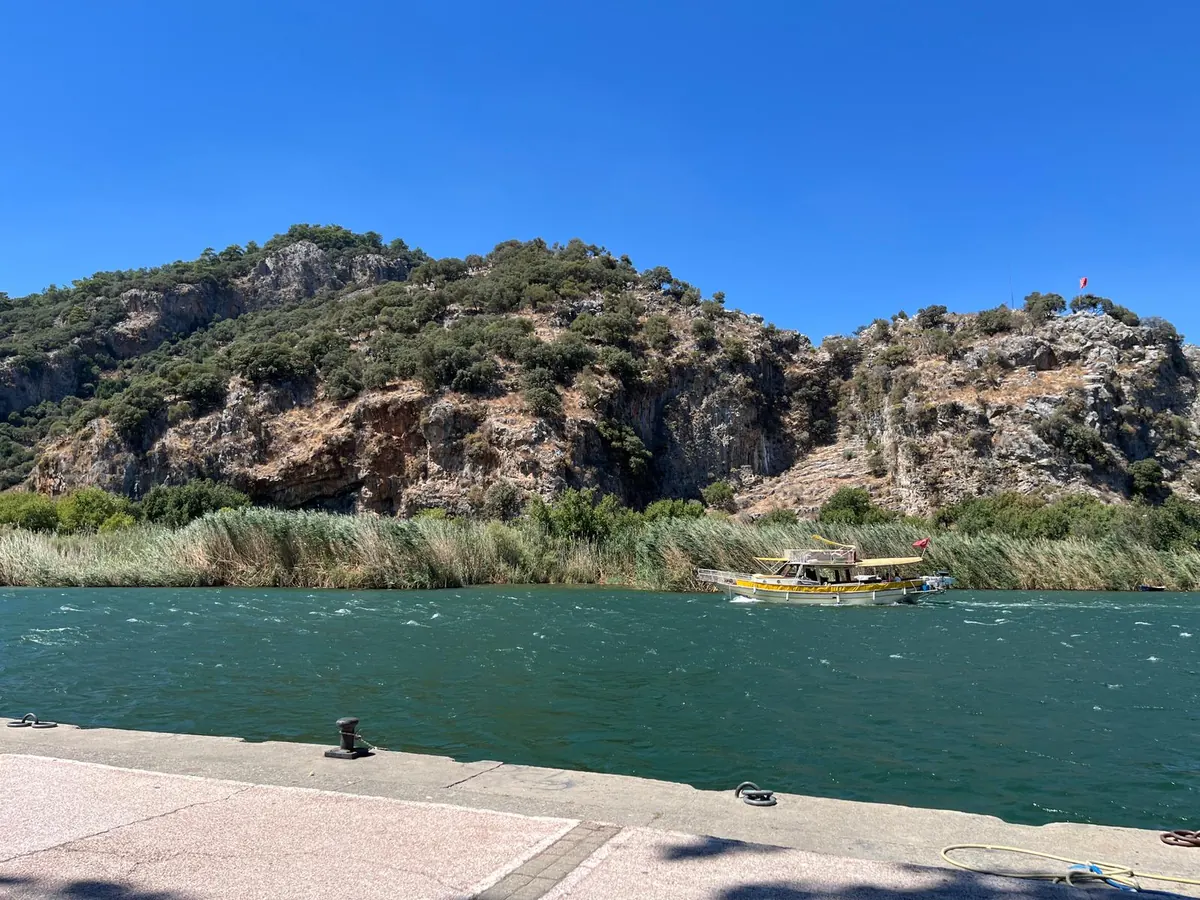
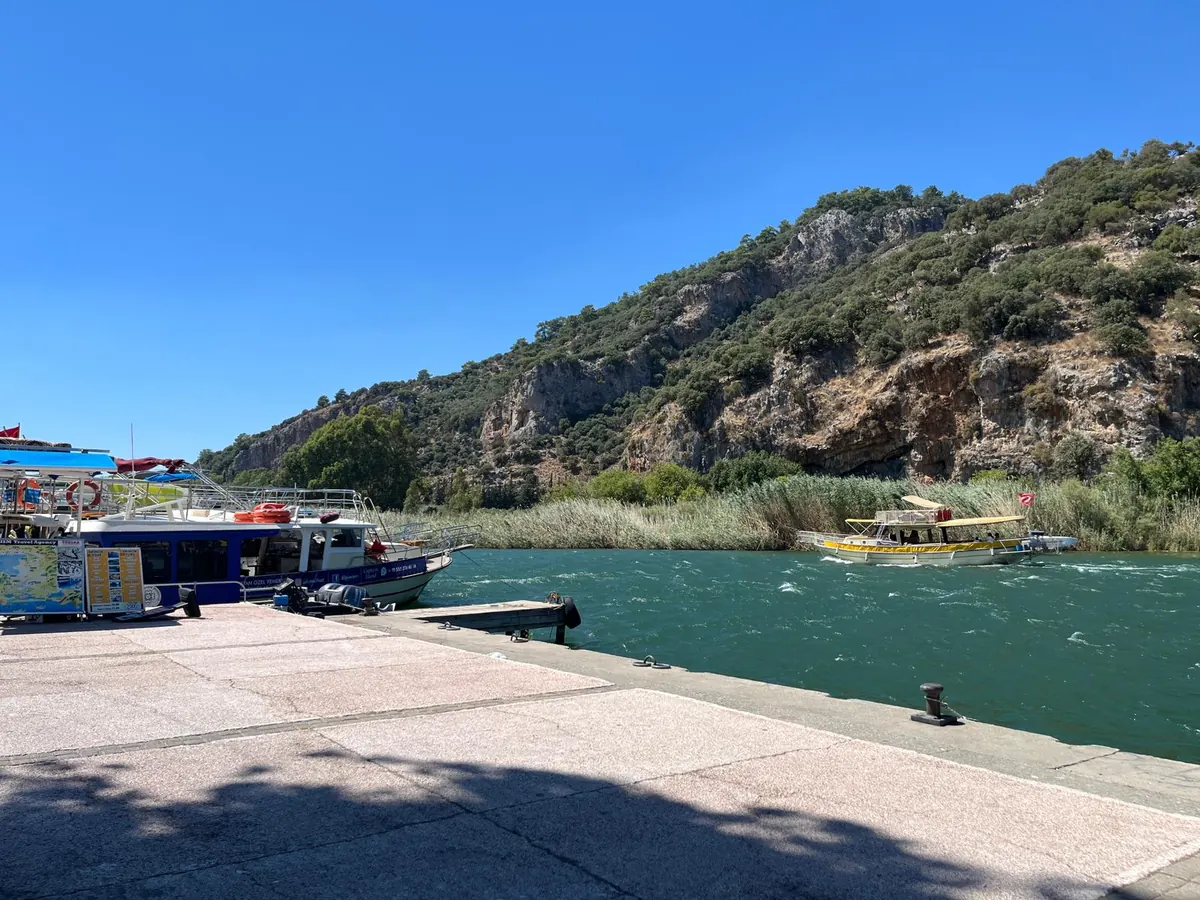
On the classic full-day river trip that means a licensed boat and skipper for roughly eight hours, from about half past nine until about half past five, every movement between the stops, tea and water on board, and pick-up from your hotel or villa inside Dalyan.
What the list leaves out is what surprises people: no entrance fees, no lunch, no sunbeds, no drinks beyond what is served on deck. That is not a trick — it is how day boats on this river have always been sold, and every operator works the same way.
Shuttle boats to İztuzu Beach are simpler still: a fixed cooperative fare for the return crossing, roughly half an hour each way, no guide and no stops.
- Licensed boat and skipper for the hours advertised
- Every boat transfer on the route between stops
- Tea and water on board
- Pick-up from your hotel or villa inside Dalyan
- English- and Turkish-speaking crew
- Not included: entrance fees, lunch, sunbeds, extra drinks
What do you pay separately, in cash, on the day?
Four things, and all four are paid in Turkish lira in cash: the Sultaniye mud bath entrance, the Kaunos site entrance if you choose to land, your lunch, and a sunbed at İztuzu if you want one.
The mud baths catch people out. The boat crosses Köyceğiz Lake to Sultaniye and waits while you coat yourself in sulphur mud and sit in the thermal pool at around 39°C, but the spring charges its own entrance at the gate. Ask for the current amount before you leave the jetty.
Kaunos is the same and optional: every boat holds position under the cliff so you can photograph the 4th-century-BC tomb façades for nothing, while the ancient city is a separate landing with its own ticket. Lunch is your choice of the beach café, food on board, or something you brought, and sunbeds are hired from the beach operator. Walking and swimming at İztuzu cost nothing.
Carry cash for all of it. Cards work in most restaurants and shops in town, but boat cooperatives, site gates, the mud baths and the beach café want notes in hand. There are ATMs in the centre of Dalyan and none at İztuzu — four and a half kilometres of protected sand with one café and no shops.
- Sultaniye mud baths — entrance paid at the gate in lira
- Kaunos ancient city — only if you take the optional landing
- Lunch — beach café, on board, or brought with you
- Sunbed and umbrella hire at İztuzu
- Drinks beyond the tea and water served on deck
Why are entrance fees not simply included in the ticket?
Because the boat operator neither sets them nor collects them. The mud baths and the archaeological site are run by other parties entirely, they price their own gates, and the money is taken on the spot.
Those amounts are also revised, sometimes mid-season, and an agency that folded them into a fare quoted in March would either be over-charging you by August or absorbing a loss. Both get solved the same ugly way — by asking for more money on the day.
And not everybody uses every gate: plenty of people look at the tombs from the deck and skip the ruins. What matters is that the exclusions are written down before you commit rather than mentioned on the boat.
How is the private boat cost in Dalyan worked out?
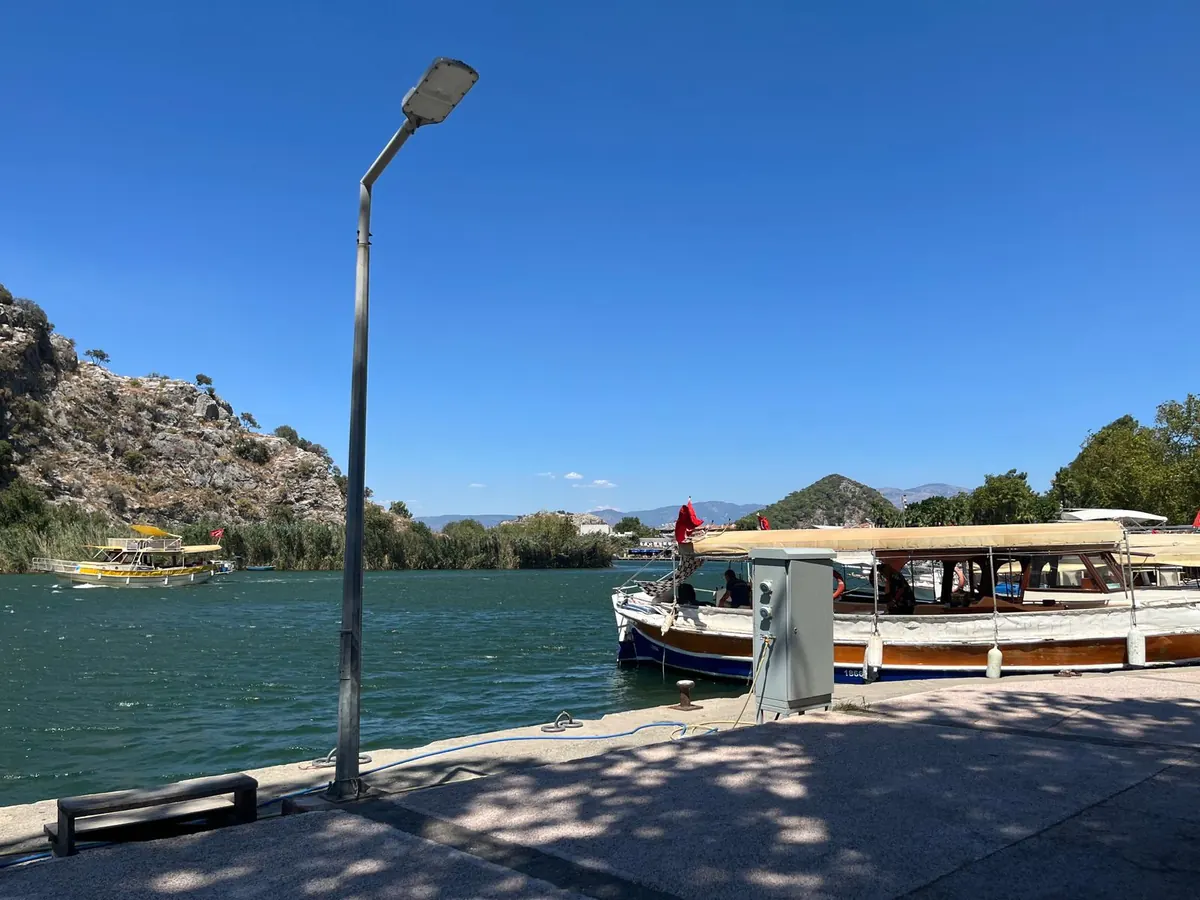
A private charter is priced per boat, not per person, and quoted as a half day of roughly four hours or a full day of roughly eight. The number of people changes which boat you need, but it does not multiply the fare the way a shared seat does.
Inside that figure: the whole vessel, a licensed skipper, fuel, harbour fees, a cool box with ice and water, and pick-up from whichever jetty is nearest you. Outside it, the same list as the shared trip — site entrances in lira at the gate, food and drink beyond water, and a gratuity, never expected and always appreciated.
Boat size is the lever you control. The fleet here runs from about six passengers up to about thirty, and there is no reason to pay for a thirty-seat deck to carry eight. Give the real number when you enquire, children included, and the boat is matched to the group.
Catering is the line people forget: a grill on the back deck is quoted separately, so a full private day is boat plus food, not one figure. Settle extra hours on the jetty too — that is an easier conversation before you leave than at anchor.
At what group size does a private boat stop costing more?
Somewhere around six or seven people, the two options converge — below that a private boat is a genuine premium, and above it the difference per head narrows fast because the fare is divided by your group rather than charged to each head.
For a couple, a charter is a deliberate purchase of privacy and control, not a saving, and we say so rather than pretending otherwise. Two people who mainly want the mud baths, the tombs and an afternoon on the sand will have an excellent day on a shared boat for much less.
For a family of six or two households travelling together, the arithmetic changes and so does the day: your own departure time, the stops in your own order, and İztuzu early enough to have a long stretch of it to yourselves. Four or five people sit in the awkward band between the two — ask for both quotes side by side rather than guessing.
How much does the season change Dalyan tour tickets?
The season changes availability more sharply than it changes the fare, and availability is what ends up costing you money. In July and August the boats are full; in May and September they are not.
May, June, September and the first half of October are the best weeks: warm sea, air you can spend eight hours in, everything open, and enough boats free to choose the one you want rather than the one left over. Charters can often be arranged a few days ahead.
July and August are peak. Air temperatures regularly pass 35°C, every operator runs at capacity and private boats sell out days before the shared seats do. Booking late then is not usually a penalty on the fare — it means being offered whatever is unsold, which is a worse day for the same money.
April and late October are a gamble that often pays off — cool evenings, an almost empty river — but fewer boats run, and from November to March most of the fleet is out of the water. Booking months ahead, ask that the confirmation states the dates the quote is held for.
What does booking direct with a Dalyan agency actually mean?
It means there is one company between you and the boat instead of three, and no intermediary taking a percentage of a fare that was already set by the local operator.
The chain in a resort town is longer than visitors realise: a booking platform takes a commission, an overseas operator takes a margin, a hotel desk takes a cut for filling the seat. Every layer is paid out of the same day on the same boat, and when they get thick the pressure comes out somewhere — less time on the beach, an added shopping stop, more bodies on the deck.
Removing the layers matters less, though, than the accountability that replaces them: the person who quotes you is the person who arranges the boat and the person you find if something goes wrong, in a town small enough that the person who quoted you is a five-minute walk away.
That puts a duty on you. Travel agencies in Türkiye are licensed by the Ministry of Culture and Tourism and registered with TÜRSAB. Ask whoever you are about to pay for their agency licence number and check it before any money moves — with us and with anybody else.
Treat pressure as information. Being pushed to decide immediately, or to pay before anything is confirmed in writing, is a warning rather than a local custom.
When do you pay, and can the price change on the day?
You pay as agreed in a written confirmation, and the amount confirmed is the amount due — nothing that was inside the confirmation is charged again on the day.
A booking exists when it is confirmed to you in writing, stating the date, the service, the number of people and the price. A message sent through a website form is not a booking and commits you to nothing, which is why asking costs nothing.
Deposits depend on what you are booking. A normal shared seat does not need one. Private charters and villas are different, because a boat or a house held for your dates cannot be resold at short notice — whatever is required is stated before you agree, not after.
Weather is the one thing nobody prices. The skipper alone decides whether the trip runs: cancelled before departure, you move to another date or take a full refund; cut short for safety after departure, the part not delivered is refunded.
What should you ask before agreeing any price in Dalyan?
Five questions turn a fare into something you can judge: how many hours, how long at İztuzu, which entrance fees are excluded, whether lunch is included, and what happens if the weather cancels the day.
The hours at the beach are the sharpest test. A trip promising the mud baths, Köyceğiz Lake, Kaunos and Turtle Beach in five hours is selling you about forty minutes on the sand. Three to four hours at İztuzu is the right answer, and a fare that undercuts everybody usually buys the difference out of that afternoon.
Two other patterns: an unexplained mid-day stop is often a shopping stop, and a remarkably low fare sometimes discovers a lunch charge halfway through. Both are avoidable by asking. And compare like with like — a shared seat, a shuttle crossing and a private charter are three different purchases.
- How many hours is the boat out, door to door?
- How long do we actually get at İztuzu Beach?
- Which entrance fees are excluded and paid at the gate in lira?
- Is lunch included, extra on board, or bought at the beach?
- Is there a deposit, and what is the weather cancellation policy?
- Is the licence number displayed, and does it check out?