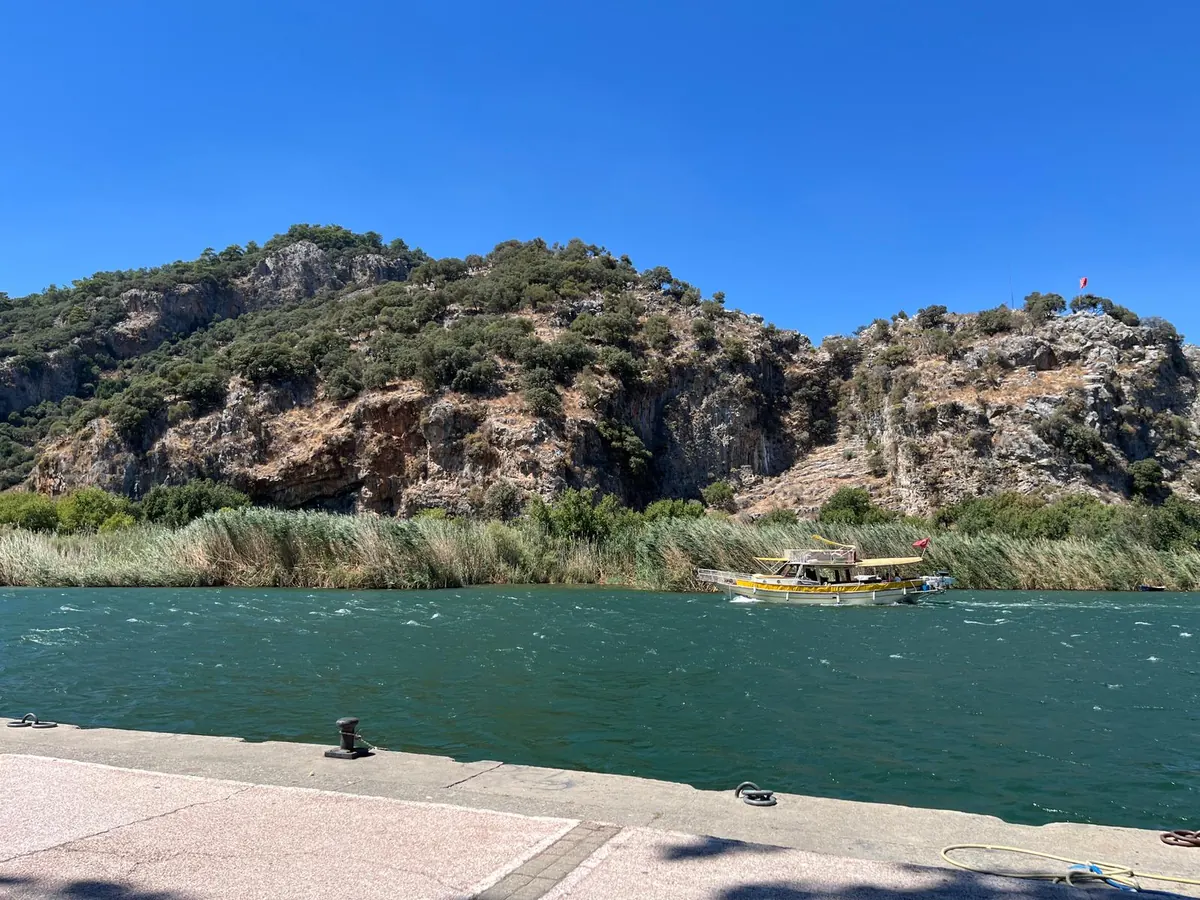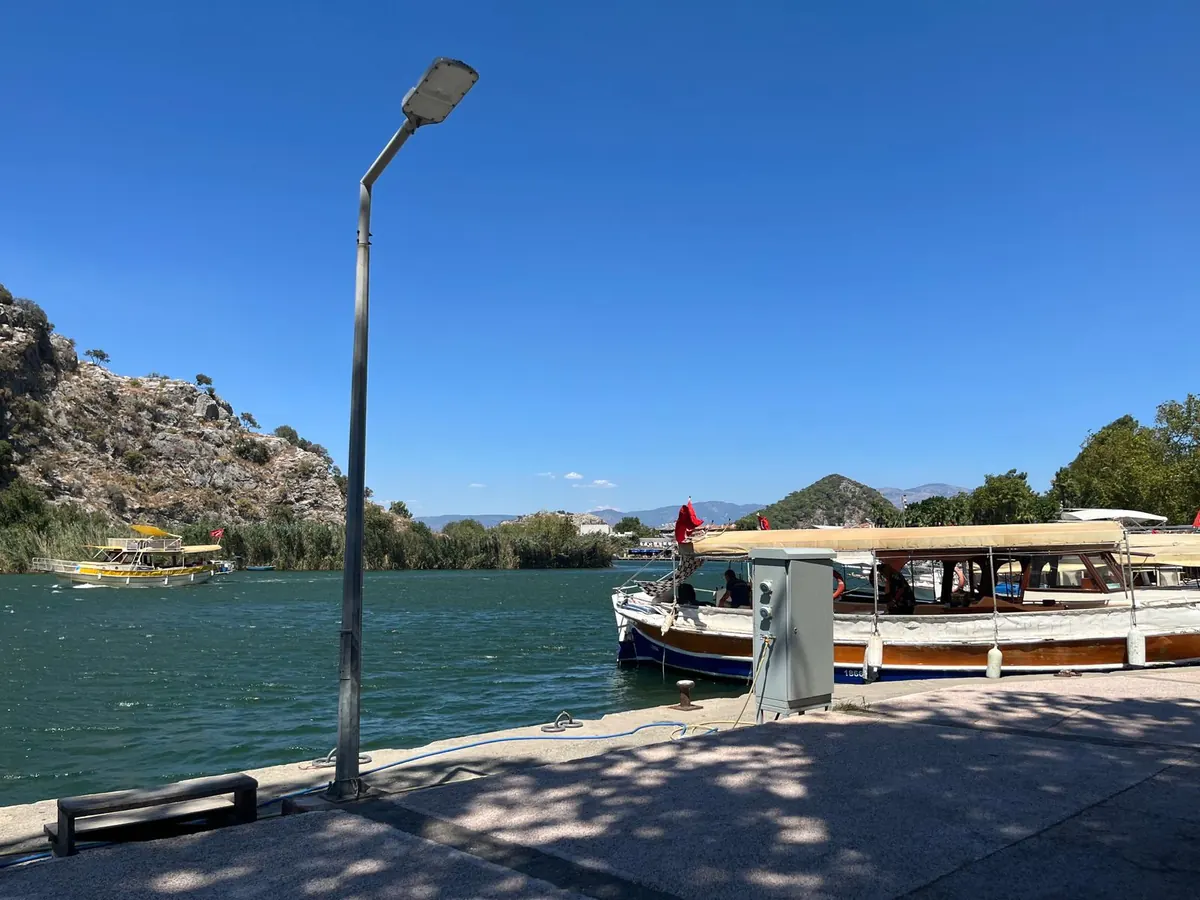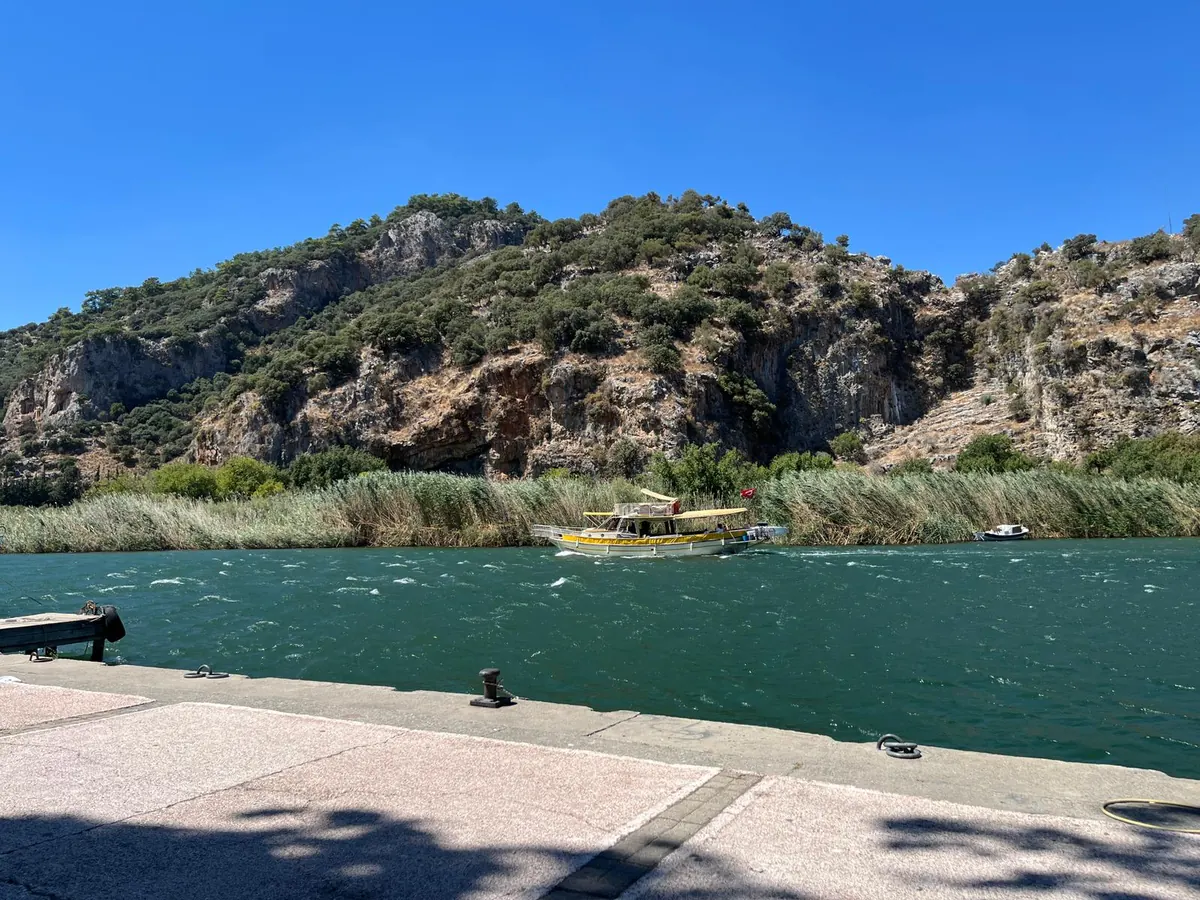
What are the Kaunos King Tombs?
The Kaunos King Tombs are rock-cut tombs carved to look like the front of a temple, made in the 4th century BC for the wealthy dead of the ancient city of Kaunos. Each one has two Ionic columns, an architrave above them, a triangular pediment on top and a small square doorway underneath. Behind the doorway is a plain chamber with stone benches cut into three walls, where the bodies were laid.
No king is known to have been buried in one. The local name — Kral Mezarları, king tombs — describes how grand they look rather than who went inside. They were cut in the century of Mausolus, the Carian satrap whose own tomb at Halicarnassus gave us the word mausoleum, and the fashion for spending a fortune on a façade that the whole city could see fits that period exactly.
Look along the row and you will find one that stops halfway. The columns are only roughed out, which shows how the tombs were made: from the top down, on ropes, cutting the face back into the cliff. It is the most informative thing on the cliff, and almost nobody photographs it.
Who were the Kaunians? A short history of ancient Kaunos
Kaunos was a Carian port city on the frontier with Lycia, and it lived off a harbour that no longer exists. The city stood on the hill behind the tombs, controlling the river mouth and everything that came up it. Its figs were famous enough to reach Rome: Cicero records a fig seller on the quay at Brundisium crying "Cauneas" — Kaunian figs — as an army embarked, and a bad pun turning it into an omen.
Herodotus, writing in the 5th century BC, said the Kaunians themselves claimed to have come from Crete, though he thought they were native to Caria. Whoever they were, they kept their own language and their own customs, and the Greek cities around them treated them as slightly foreign. The city later passed through Persian, Hellenistic, Rhodian and Roman hands without ever becoming large.
The city outlived its harbour and then lost to it. The river carried silt down from the mountains year after year, the bay behind the city filled in, and the port that made Kaunos rich became the reed bed you now travel through to reach it. That slow process ended the city: the sea is now several kilometres of reed and sandbar away.
The delta also made the place sick. Ancient writers remarked on the sallow complexion of the Kaunians and blamed the summer air off the marshes; we would call it malaria. Excavation began in the 1960s and continues, which is why the theatre, the Roman baths and the harbour agora are legible today instead of being humps in the scrub.
Why does a Carian city have Lycian rock tombs?
Kaunos is Carian, but the tombs are Lycian, because the city sat on the line between the two. Rock-cut tombs with temple façades are the signature of Lycia — the country to the east, where you find them at Fethiye, Tlos, Xanthos and Myra — and Kaunos is about as far west as the style travelled in this form.
Borders in the 4th century BC were gradients rather than lines. Kaunos traded east into Lycia and west into Caria, spoke its own language, and buried its rich in the manner of its eastern neighbours because that was the most impressive thing on offer. Cities copy the funeral architecture of whoever they would like to be mistaken for.
Where they were placed matters to anyone holding a camera. The tombs are cut high on the face that looks out over the water, not on the landward side, so that a ship coming up to the harbour met the dead of Kaunos before it met the living. Some two and a half thousand years later they are still best seen from a boat. It is the one piece of ancient town planning here that has survived completely intact.
How close does the boat get, and what will you actually see?
A tour boat holds position under the cliff for a few minutes, close enough that a single façade fills the frame on a short telephoto. You cannot land and you cannot climb to them — the ledge is fenced, the rock below it loose — so the water is as close as anyone gets.
There are four ways to be in front of them. The full-day shared trip passes on its way through, usually in the early afternoon. The İztuzu shuttle boats run up and down all morning and pass the cliff in both directions. A private boat lets you choose the hour, which is the only way to control the light. And the sunset cruise holds position there on purpose, for the last of the day.
Sit on the right-hand side going downstream. Heading south from the town jetty towards the beach, the cliff is on your right; coming back it is on your left. On a shuttle boat with fixed benches, that one decision is worth more than any camera setting you will change all day.
The boat is never quite still. Even at idle it turns on the current, and the wash of a passing boat reaches you seconds after it has gone. Plan around the movement rather than fighting it.
- Full-day shared boat trip — passes early afternoon, the flattest light of the day
- İztuzu shuttle boat — cheap, frequent through the morning, passes twice
- Private boat — you choose the hour, which is the whole point
- Sunset cruise — holds position for the last light and the floodlights on the way back
- The small ferry across the river to the Kaunos site — two or three minutes, very low on the water
What is the best time of day to photograph the Kaunos rock tombs?
The first three hours after sunrise give the best light on the façades, and the middle of the day gives the worst. Early on, the light comes across the river from the town side and rakes along the columns, so the pediments throw shadows and the depth of the cutting reads. By one in the afternoon it falls almost vertically, the shadows collapse and the cliff photographs as a flat grey wall — which is when most shared boats arrive.
The last hour of daylight is a different photograph rather than a better one. The stone goes dark and cool while the sky behind the ridge takes the colour, and a silhouetted cliff over a river with a boat on it beats a badly lit façade every time. Expose for the sky, let the rock go black, and stop trying to rescue the shadows.
Sunset times, if you are planning a private boat around them: roughly 19:40 in mid-April, 20:30 in late June, 19:15 in mid-September and 18:40 in mid-October. Türkiye stays on UTC+3 all year and does not put the clocks back, so autumn evenings shorten quickly. The useful light starts about forty minutes before those times.
In July and August there is a second problem at midday: heat haze over the water. Across a few hundred metres of river at 35°C it softens everything a long lens sees, and sharpening afterwards will not put it back. That alone argues for a morning boat in high summer.
After dark the tombs are floodlit and the colour on them is orange and even. It is a real photograph, but not from a boat — the exposure runs long enough that you need something solid under the camera. Shoot it from the town waterfront with your elbows on a railing or the camera set down on a table.
Camera settings that survive a moving boat
Shutter speed is the whole problem. On a drifting deck with a long lens, 1/500 second is the floor and 1/1000 is safer. Push the ISO to get there and accept the noise, because a clean blurred photograph is still a blurred photograph.
On a phone, the only setting that really matters is which lens you are using. Press the telephoto button — 2x or 3x, whatever your phone has as an actual lens — and stop there. Anything beyond the longest optical lens is the phone inventing pixels. Tap the tombs, hold to lock the exposure, slide it down slightly, and shoot a burst. Then wipe the glass: sun cream on a phone lens is the single most common cause of a hazy holiday photograph on a boat day.
- 70–200 mm equivalent — one or two façades filling the frame
- 24–35 mm equivalent — the whole cliff with river and reeds for scale
- 1/500 s minimum, 1/1000 s if the light allows
- Continuous autofocus and a three or four frame burst per attempt
- Minus a third to minus two thirds of a stop so sunlit limestone does not clip
- A polariser cuts glare off the water but costs one and a half to two stops — take it off in the shade
- No tripod on a boat. Elbows against your ribs, knees soft, breathe out as you press
- A spare battery or power bank: heat, screen brightness and burst shooting flatten a phone by mid-afternoon
The best photo spots, from the water and from the town
The strongest single position is mid-channel a little downstream, not directly beneath the cliff. Underneath, you are looking steeply up and the façades foreshorten into slits; from a hundred metres back the temple fronts sit square to the camera and the cliff keeps its full height inside the frame.
The town waterfront is the underrated one. You need the long lens, but you are on solid ground rather than a moving deck, you can wait for the light, and you get a foreground — fishing boats, wooden jetties, a table by the water — that turns a picture of a cliff into a picture of a place.
The small ferry across the river to the Kaunos site puts you very low on the water for two or three minutes. Low angles exaggerate height, so the cliff looks taller from a rowing boat than from the deck of a tour boat. Take the frame during the crossing, not from the landing stage.
- Mid-channel, 80–150 m downstream — the square-on view, best overall
- Directly under the cliff — dramatic and foreshortened, good for one façade
- The Dalyan waterfront promenade — stable ground, long lens, foreground boats
- The river ferry crossing to Kaunos — lowest angle available, cliff at its tallest
- The Kaunos acropolis — not for the tombs, but for the delta laid out below
Six mistakes that ruin the photograph
Almost every disappointing picture of the tombs fails for one of six reasons, and five of them are decided before you press the shutter.
- Shooting wide. The tombs are a few hundred metres off and the default phone lens turns them into a beige stain in the middle of a big green frame.
- No sense of scale. A bare cliff could be four metres tall or forty. Put a boat, a person or the reed line in the frame and the tombs get their size back.
- Digital zoom past the longest optical lens. It looks fine on the phone screen and falls apart on anything larger.
- Midday in July, expecting warm stone. That light does not exist at that hour; move the trip, not the editing sliders.
- A dirty lens. Sun cream, spray and pocket lint, in that order.
- Waiting for the return leg. The light may well be better on the way home, but by then the boat is running straight past and everyone is asleep in the shade.
Can you walk up to the tombs, and is the ruined city worth it?
You cannot walk up to the tomb façades, but you can walk around the city they belong to, and it is worth an hour or two. The façades are fenced and the rock beneath them is unstable, so the closest approach is from the water.
The site is reached by the small ferry across the river from the town, then a walk of about ten minutes. There is a theatre cut into the hillside, an acropolis with a long view down the delta, Roman baths, a basilica and the agora of the harbour that silted up. An entrance fee is collected at the gate and paid in lira, so carry cash.
Go early or late. There is almost no shade, the stone holds the heat, and the climb to the acropolis is steeper than it looks from the bottom. Take water, a hat and shoes with grip — the worn marble underfoot is polished smooth.
For photography, the site gives you the delta rather than the tombs. From the theatre and the acropolis you look over the reed beds, the bends of the river and the four and a half kilometre line of İztuzu between the fresh water and the sea. That is the wide shot; the tombs are the close-up, and for those you need the boat.