Why is the evening the best time to be on the Dalyan delta?
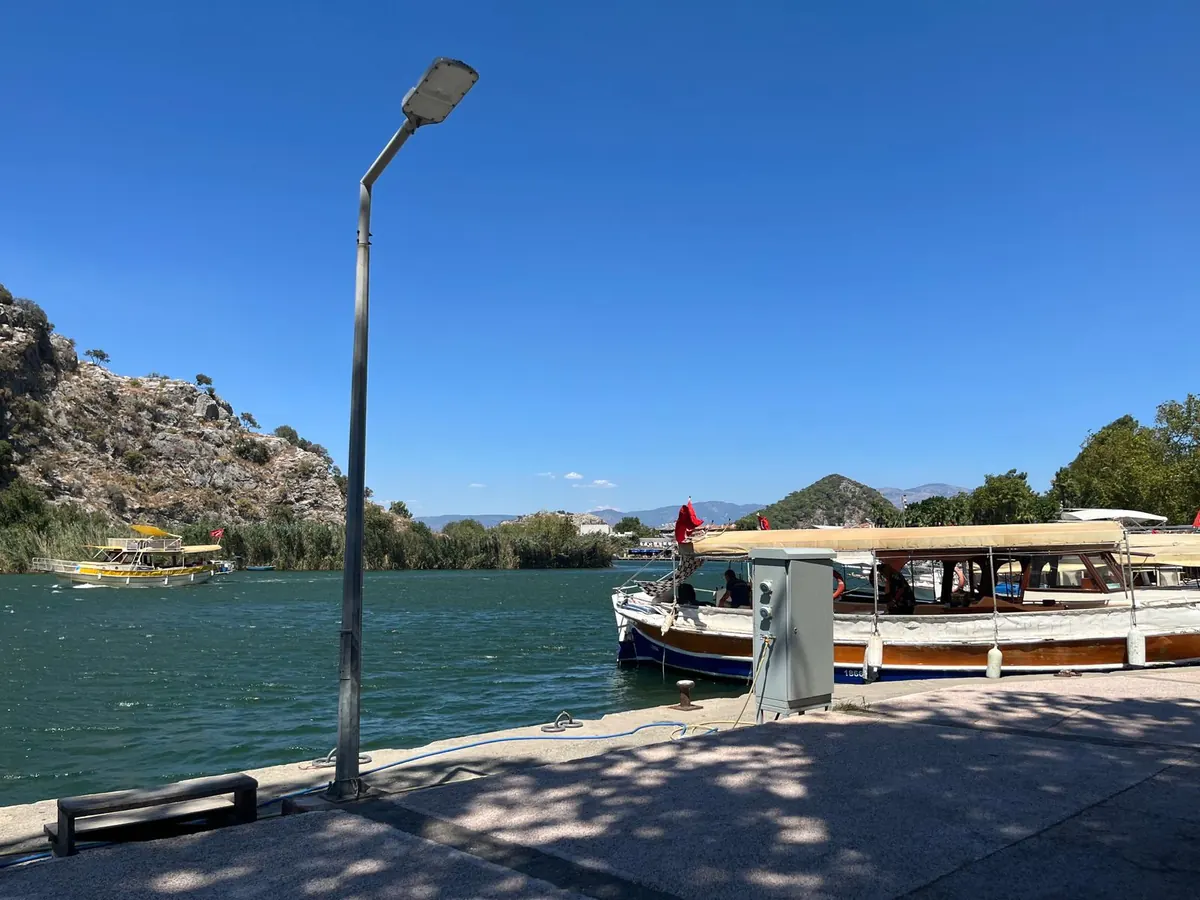
Because the light is better, the channel is empty and the air is finally bearable. Between about 09:30 and 17:30 the delta carries every full-day boat in town on the same route — mud baths, Kaunos, İztuzu, in that order. By seven in the evening almost all of them are tied up.
Heat is the other half of it. July and August regularly go over 35°C and the reed beds hold that heat like a wall. An afternoon on an open deck in August is something you get through; the same deck at half past six, moving, with the sun off the water, is a different holiday altogether.
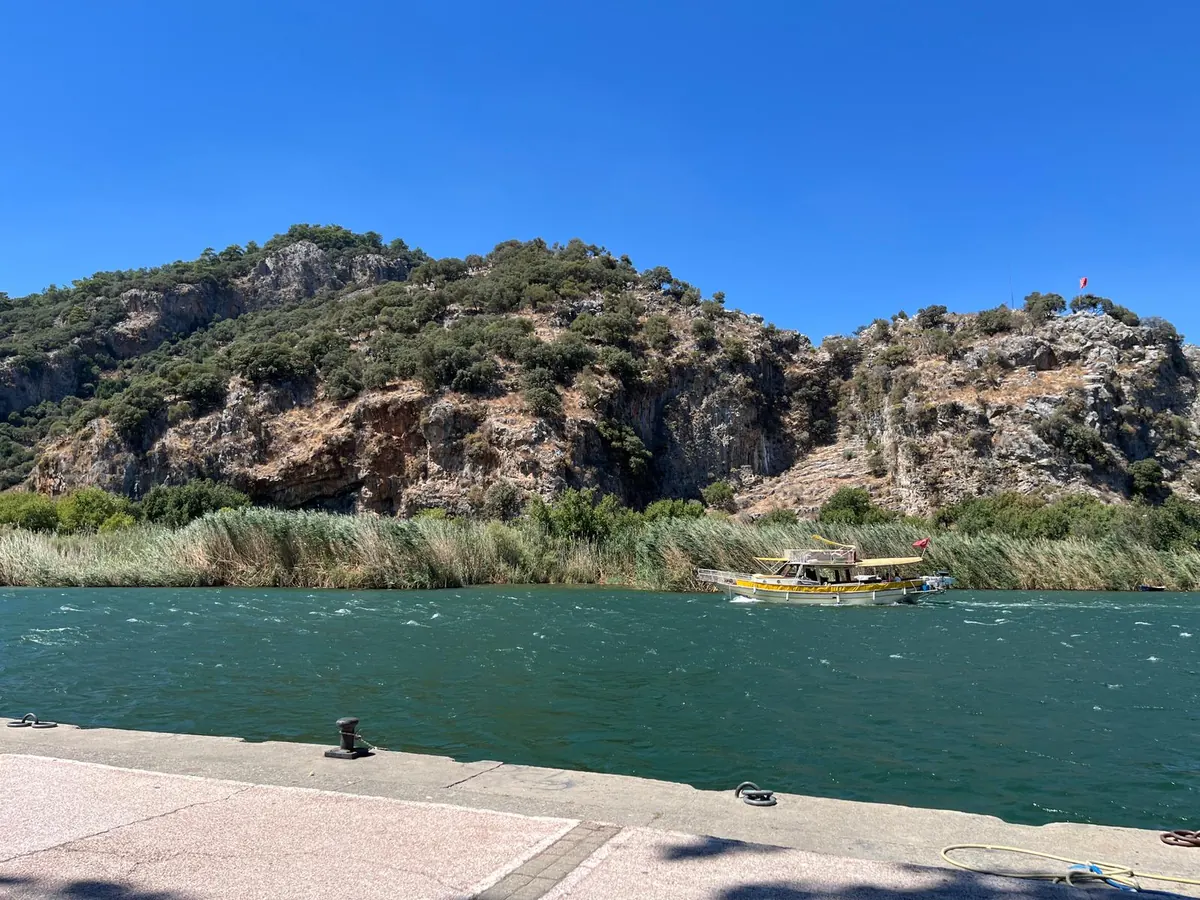
The delta behaves differently at that hour too. Herons and egrets come back to roost in the reeds, the day’s wake dies out of the channel, and the water flattens enough to mirror the cliff. You hear frogs, the engine, and very little else.
What happens on a Dalyan sunset boat trip, hour by hour?
The standard evening cruise runs about two hours and is built around one moment: holding position under the rock tombs while the colour changes on them.
The longer version — what people usually mean when they ask about a Lake Köyceğiz evening cruise — leaves earlier and runs three to four hours. Same channels, then out onto the open lake for a swim stop, and often the Sultaniye thermal pool on the far shore before the boat turns for home.
- Pick-up at your jetty in Dalyan, roughly 90 minutes before sunset. The exact time moves week by week; we confirm it the day before.
- Twenty minutes through the reed channels with the engine down — slower than the day trip, mostly drifting, reeds three metres tall on both sides.
- Thirty to forty minutes below the Kaunos rock tombs while the light works. The skipper holds the boat against the current so the façades stay in frame.
- Out towards the mouth of Köyceğiz Lake as the colour goes, with tea or a cold drink on deck.
- Back into Dalyan in the dark, passing under the tombs with the floodlights on them.
What time do evening boats actually leave?
Departure follows the sunset, and the sunset in Dalyan moves by more than an hour and a half across the season. It is around 19:50 in early May, around 20:30 in the last week of June, and back to around 18:50 by the start of October.
Evening boats run from May to October. In April and late October the sun goes early, the river cools quickly after dark and fewer boats bother — it can still be a good hour on the water, but ask rather than assume.
We confirm the exact departure the day before, because the number that matters is not the published sunset but the twenty minutes before it, and that depends on where the ridge behind the tombs is throwing its shadow that week.
- Early May — sun down about 19:50, boats leave about 18:20
- Late June — sunset about 20:30, the latest starts of the year, around 19:00
- Early September — sunset about 19:35, departure about 18:05
- Early October — sunset about 18:50, departure about 17:20
Can you swim in Lake Köyceğiz during the cruise?
Yes, on the longer evening trips that go out onto the lake: the skipper cuts the engine in open water, drops a ladder off the stern, and people go in from the boat.
Köyceğiz Lake covers roughly 50 square kilometres and drains to the Mediterranean through the five kilometres of reed channel that Dalyan sits on, so the water is brackish — part fresh, part sea. It is deep in the middle and it is green. You will not see your own feet.
That is worth saying plainly, because photographs of Türkiye sell turquoise. If clear water is the point of your holiday, the open sea in Fethiye Gulf is where to spend a day. The lake sells something else entirely: floating in the middle of open water with the Taurus mountains behind you, the sky going orange, and not another boat in sight.
In July and August the surface holds the day’s heat and nobody hesitates on the ladder. In May and early October it is cold enough that half the boat stays dry, which is a fair warning rather than a problem. There is no lifeguard on a boat — children go in wearing jackets, next to an adult.
What is a Dalyan moonlight boat tour, and when does it run?
A moonlight tour is the same evening route pushed later and timed to the full moon, when the moon comes up within minutes of the sun going down and there is enough light on the water to read the reed line without a torch.
That timing is astronomy, not marketing. A full moon sits opposite the sun, so it rises as the sun sets. The cycle is 29.5 days, which gives one usable window a month — the night of the full moon and the two either side. Across a May-to-October season that is about six windows, and they are the first evening dates to go.
The rest of the month offers the opposite trip. With no moon you see far less of the landscape and far more sky: the delta is a Specially Protected Area with no coastal strip, no floodlit hotels and nothing built on the sandbar, so the dark over the reed beds is genuinely dark. Decide which of the two you want before you pick a date, because they are not the same evening.
Is the Sultaniye thermal pool worth doing in the evening?
The pool is better in the evening than in the middle of the day. The mud is not.
Sultaniye is on the far shore of the lake, roughly 45 minutes from the town quay by boat. The thermal water sits at around 39°C, and an hour in it with the air cooling and the day’s crowds gone is one of the better hours of a week here.
The mud is a different question. The ritual only works in strong sun: you coat yourself, you stand about until it dries and cracks, then you rinse it off. After six in the evening there is nothing to bake it, so an evening stop is a soak and not a mud bath. If the grey mud is what you came for, keep it for the day trip.
Two practical points. The entrance fee is charged at the gate in lira and is not part of the boat, and the closing time shifts with the season — we check it the same day rather than promise you a pool that has already shut. Sulphur also sinks into swimwear permanently and will tarnish a silver ring, so wear something old and leave rings on the boat.
Do you see the Kaunos rock tombs lit up at night?
Yes — they are floodlit after dark and the boat passes beneath them on the way home — but the light worth planning your evening around is the forty minutes before the sun goes.
The tombs are temple façades, columns and pediments and all, cut straight into the cliff in the 4th century BC. They belong to Kaunos, a Carian city that built in the Lycian style, and they look back across the water at the town. Nobody climbs up to them; the viewpoints are the river bank and the deck of a boat.
For photographs: the honey stage lands roughly twenty to forty minutes before sunset and a phone handles it well. The floodlit version afterwards, shot from a boat that is never quite still, does not — that one wants a camera you can push to a high ISO and a hand steady enough for a quarter of a second.
Why evening boats never go down to İztuzu Beach
Because loggerhead turtles nest on İztuzu from May to September, and the beach is closed at night throughout those months.
İztuzu is 4.5 kilometres of sand sealing the river off from the sea, protected since 1988 after a campaign stopped a hotel being built on it. In nesting season nobody is on the sand after dark, no vehicle goes on it, and light near the water is a real problem — hatchlings running for the sea from July onwards steer towards the brightest horizon, which is meant to be the open Mediterranean.
So an evening trip in Dalyan is a river and lake trip, full stop. If anyone offers you a night landing at Turtle Beach in season, that tells you something useful about who you would be booking with.
Who an evening cruise suits, and who should skip it
It suits people who want the river without the day — and it does not replace the full boat trip, it sits alongside it.
- Couples, anniversaries and proposals. A good share of the private evening boats in Dalyan go out for exactly this; tell us in advance and you will not be sharing a deck.
- Anyone who has already done the eight-hour trip and wants the same water with nobody on it.
- People who landed at Dalaman that morning — 25 km and 25 to 30 minutes away. Two hours in the cool beats eight hours in the sun on your first day.
- Photographers, for obvious reasons.
- Skip it if you want the mud ritual, İztuzu or clear open sea. None of the three is on an evening boat.
- Skip it if you will not use repellent. It is a delta in summer and the mosquitoes come out at dusk with everything else.
- Think twice with a toddler on a bedtime routine: you are back at the jetty after dark, which in late June means around nine.
What to bring on an evening boat trip
Bring a layer, repellent, and a towel if a swim stop is on your route — the rest is the same short list as any boat here.
- A light layer or a fleece. The river cools fast once the sun is off it and a moving boat makes it cooler still.
- Mosquito repellent, on before you board rather than when you notice.
- Swimsuit and towel if the lake stop or Sultaniye is included — and for Sultaniye, an old swimsuit you do not mind losing to sulphur.
- Cash in lira for the thermal entrance if you are stopping there.
- A camera that copes with low light, or the acceptance that a phone will not.
- Your own wine or beer if you want it. Tea, water and soft drinks are on board; alcohol is not, and we will put yours on ice.
How evening cruises are priced and booked
Shared evening boats are priced per person and private boats per boat, and the gap between them closes faster than people expect: once a group reaches six or seven, hiring the whole boat is often close to the same money and a completely different evening.
Inside the price sits the boat, the skipper, tea, water and soft drinks, and pick-up from your jetty in Dalyan. Outside it sit the Sultaniye entrance, paid at the gate in lira, dinner, and anything alcoholic. We do not print a figure on this page because it moves with the season, the boat and whether you are sharing — send a date and you get that day’s real one.
Book evening dates earlier than you would book a day trip. Sunset cruises and private charters are the first things to go in July and August, partly because there is one departure a night rather than a quay full of them each morning.
Weather cancellations are the skipper’s call and always ours to make good — another date, or the money back. We would rather tell you the evening is not worth going out for than sell you two hours of cloud.