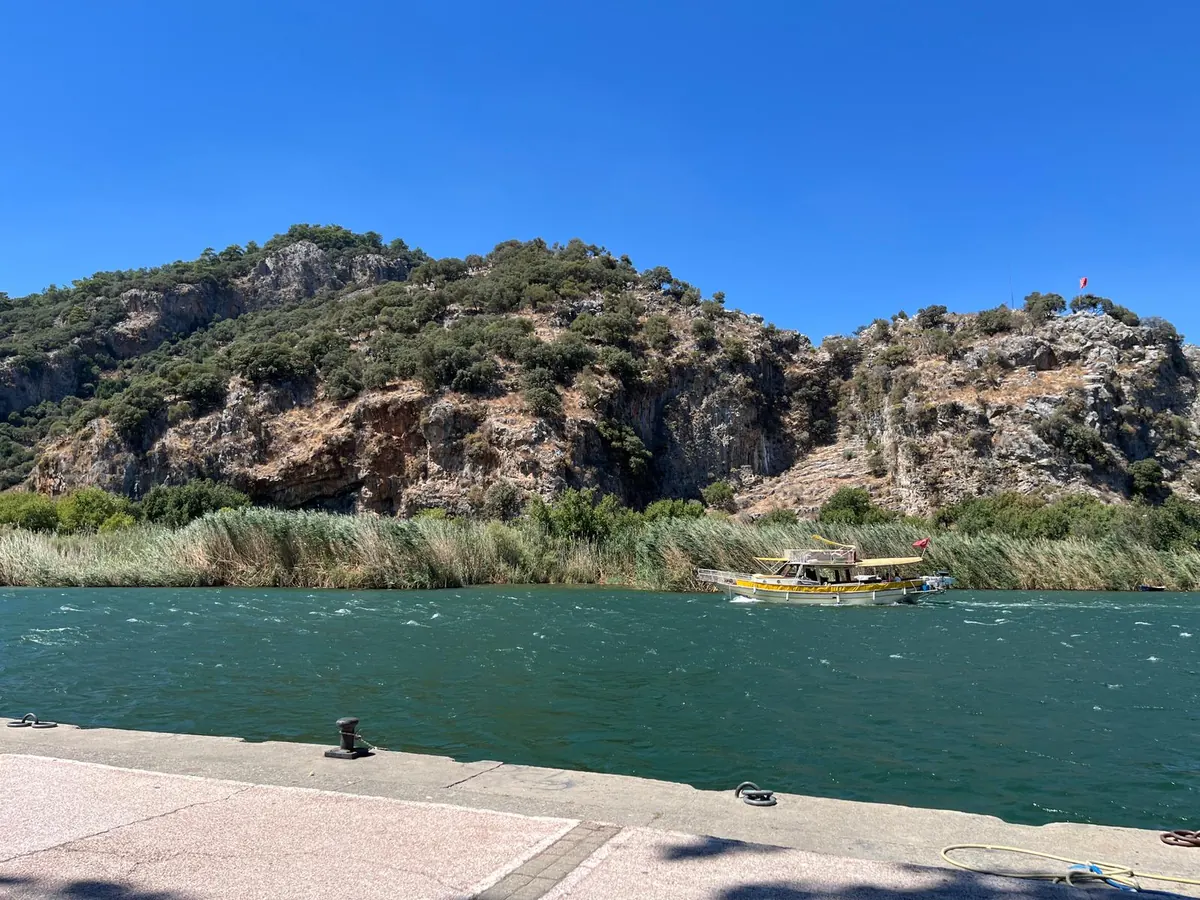
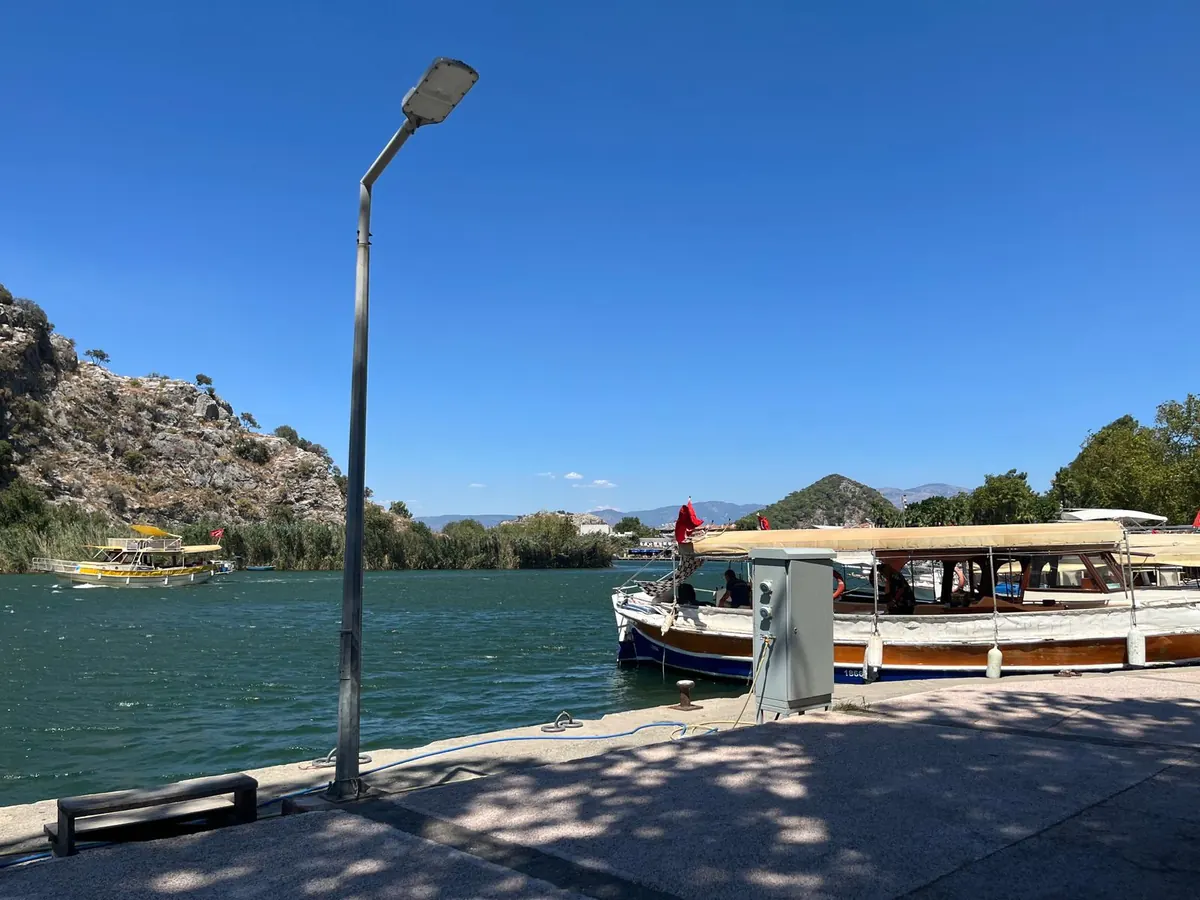
What are the Dalyan mud baths, and where exactly are they?
The mud baths that Dalyan boat trips visit are at Sultaniye, a sulphur spring on the far shore of Köyceğiz Lake, about forty-five minutes by boat from the town quay. They are not in Dalyan itself. There is no mud in the town, which regularly surprises people who booked a room on the river expecting to walk to it.
The site is a walled compound rather than a spa. There is an open pool of grey mud you wade into, showers and a rinse pool to wash it off, and a covered thermal pool fed by the spring. Changing rooms, lockers and a café are all there and all basic. Nothing about it is polished, and that is broadly the appeal.
The springs are old. They were in use when Kaunos was a working Carian harbour city in the 4th century BC, further down the same water. The buildings you actually walk through are modern and unremarkable, so do not arrive expecting Roman marble — the interest here is the water and the mud, not the architecture.
One thing to check before you book: there is more than one mud bath in the Köyceğiz and Dalyan basin, and they differ in size and condition. Ask which one your boat stops at. If the answer is vague, that is information too.
How does the mud bath ritual work, step by step?
There are five stages and the whole thing takes forty-five minutes to an hour without rushing: into the mud pool, coat yourself, dry in the sun until the mud cracks, rinse it off, then soak in the thermal pool.
Nobody looks good doing this, and that is most of the point. It does more for a boatload of strangers than any beach stop.
Do the mud before the thermal pool rather than after. The hot pool is the reward at the end, and getting in still coated means carrying half the mud pool into it, which the attendants will have views about. Rinse properly at the showers first.
- Get into the mud pool. It is shallow — thigh to waist — with a soft bottom and slippery steps. Take them slowly.
- Coat yourself. Arms, legs, face, hair if you are committed. Scoop from below the surface, where the mud is smoothest and free of grit.
- Dry in the sun, standing still. The mud tightens, goes pale grey and cracks along every crease. Under fifteen minutes in high summer, noticeably longer in April.
- Rinse. Showers and a rinse pool. Deal with your hair now rather than discovering the problem at dinner.
- Soak in the thermal pool last, at around 39°C. Fifteen minutes is plenty.
What is the Sultaniye thermal water actually like?
Hot, cloudy and unmistakably sulphurous — around 39°C, roughly two degrees above body temperature, and it feels considerably hotter than that after ten minutes in it.
The smell is hydrogen sulphide and it is the honest signature of the place. It stays on your skin for the rest of the day and in your swimsuit for the rest of the week. Rinse thoroughly, wash the costume in cold water the same evening, and accept that anything white will not come back quite the colour it went in.
On what the water does: people around Köyceğiz will tell you it helps rheumatism and skin complaints, and thermal springs are used that way all over Türkiye. We run boats, not a clinic, and we are not going to make a medical claim on a web page. Treat it as an unusually good hot bath in an unusual setting, and count anything else as a bonus.
One caution that is worth taking seriously. Water at 39°C puts a real load on the heart. Fifteen minutes is enough for most people and longer is not better. If you are pregnant, have a heart condition or take blood pressure medication, ask your doctor rather than your skipper.
What is the boat journey from Dalyan to Sultaniye like?
It is about forty-five minutes each way from the Dalyan quay, and it is the best stretch of water on the whole day trip.
The first part is the reed labyrinth. Channels barely wider than the boat, reeds three metres tall on both sides, herons lifting off ahead of the bow. There are five kilometres of this between the town and the lake, and the skippers navigate it from memory rather than from any marked route.
Then the reeds simply stop. Köyceğiz Lake opens out — a wide flat sheet of fresh water with the Taurus mountains standing behind it — and Sultaniye is across on the far side. The change from a two-metre channel to open lake happens in about thirty seconds and it is the photograph most people miss because they are still looking backwards.
All of it is flat water. If somebody in your group is worried about seasickness, this is the trip they can do: no swell, no open sea, and the delta is a Specially Protected Area, so there are no jet skis or speedboats churning it up either.
When should you go to miss the crowds?
Before 09:30 or after 17:00. Almost every shared boat in Dalyan leaves the quay at about half past nine and reaches Sultaniye inside the same forty-five-minute window, so the site goes from quiet to four boats deep in a quarter of an hour.
The standard itinerary puts you there around 10:15. In July and August that means waiting your turn to get into the mud and standing shoulder to shoulder while it dries. It is still enjoyable. It is not the version in the brochure photographs.
There are three honest ways round it. Take a private boat and set your own departure — an eight o’clock start gets you there as the site is opening. Go separately in the late afternoon once the day fleet has gone home, which is exactly what the jeep safari day does on its way back from the hills. Or come in May, June, September or early October instead of high summer, when there are fewer boats and the air is under 30°C rather than over 35°C.
Heat matters more at this stop than anywhere else on the route. Standing still in direct sun coated in drying mud at two in the afternoon in August is a different activity from doing it at nine in the morning in June, and the difference is not small.
What to bring, and what to leave on the boat
Bring a swimsuit and a towel you would not mind ruining, cash in Turkish lira, and something on your feet. Leave every piece of jewellery on the boat, silver above all.
The jewellery warning is chemistry, not folklore. Sulphur tarnishes silver black within minutes and it does not simply polish out afterwards. Wedding rings, earrings, watches, necklaces — all of it goes into a bag on the boat before you get anywhere near the pool. Every skipper in Dalyan has a story about a ring lost in the mud, and none of the stories end well.
If you wear contact lenses, keep the mud off your face or take them out first. It stings, and rinsing your eyes with sulphur water is not the fix you want it to be.
- An old swimsuit. Sulphur stains fabric and the smell does not fully wash out. This is not superstition — it is simply what happens.
- A towel you do not care about, plus a second dry one for afterwards if you have the space.
- Flip-flops or water shoes. The wet concrete between the pools is slippery.
- Cash in Turkish lira. The entrance is paid at the gate and card is not something to rely on.
- A zipped bag for your phone. Mud gets into charging ports and stays there.
- A hairband if your hair is long. Mud in long hair turns the rinse stage into twenty minutes.
Who should skip the mud baths?
Skip it if you have open wounds, a fresh tattoo, recent surgery, or a skin condition that is currently flaring. This is a shared open-air mud pool used by every boat that comes up the lake, and it is not a sterile environment.
Think twice as well if you are pregnant, have a heart condition, or find very hot water difficult. And if you simply do not want to stand in a public pool covered in grey sludge, that is a perfectly reasonable position — stay on the boat with a tea. Nobody in the crew will think anything of it, and the trip loses none of its other stops.
Small children usually love the mud and hate it anywhere near their eyes. Keep it off faces, keep them out of the hot pool entirely, and it becomes one of the better stops of their day. Thermal water at 39°C is not for toddlers under any circumstances.
The site is not especially accessible either. There are steps into both pools, uneven wet ground, and nothing we would describe as a reliable ramp. Tell us in advance if anyone in the group has mobility difficulties and we will give you a straight answer about whether it will work rather than letting you find out at the gate.
What does it cost, and what is included?
The boat journey and the waiting time are part of your trip. The entrance to Sultaniye is not — it is charged separately at the gate by the operators of the site, paid in Turkish lira, and it is one of the two or three cash items on a Dalyan boat day.
We do not print an amount on this page. The entrance is set by the site rather than by us and it changes; a number published in one season is misleading by the next. We tell you the current figure when you book instead, so you step off the boat with the right cash in hand.
Budget for a few extras on the same basis: a locker, a towel if you arrived without one, a cold drink at the café. All cash. There is nothing to buy for the crossing itself, and no time pressure beyond the hour the skipper has allowed.
How does the mud bath fit into a full day on the delta?
It is stop two of four on the classic Dalyan boat trip, and it belongs early in the day. The usual shape is: 09:30 from the town quay, 10:15 at Sultaniye for about an hour, a slow crossing of Köyceğiz Lake around 11:45, the Kaunos rock tombs from the water at about 13:00, three to four hours on İztuzu Beach from 14:00, and back in Dalyan by 17:30.
That order is deliberate. The mud goes first because the beach afterwards gives you salt water and a proper shower to finish the job. Kaunos sits in the middle because the tombs — temple façades cut straight into the cliff in the 4th century BC — hold the light best from the boat while the sun is still high. İztuzu goes last because four and a half kilometres of sand, protected since 1988 and closed at night through the May to September turtle nesting season, is worth an afternoon rather than a stop.
If a boat offers you all four in five hours, do the arithmetic before you pay. Something has to be cut, and it is always the beach.