How far is Dalyan from Marmaris, and how long does the drive take?
Dalyan is roughly 80 kilometres from Marmaris by road, which is about an hour and twenty minutes each way in a car and closer to an hour and a half in August traffic. From İçmeler, add fifteen to twenty minutes at both ends.
The route climbs out of Marmaris on the D400, drops to the head of the Gökova gulf, then runs east past Köyceğiz Lake to Ortaca. Dalyan is signposted six kilometres off the main road, and the last stretch runs down through cotton and citrus fields to the river.
That is two hours and forty minutes of road in one day, and no operator can shrink it. What does change is whether those minutes are spent going straight there, or spent sitting in a coach that is still inside Marmaris an hour after it collected you.
What is the real difference between a coach excursion and a private transfer?
The difference is about two hours of your day and roughly forty-five other people. Both take you to the same river and the same beach; they deliver very different amounts of each.
A coach has to fill itself before it can leave. That means a circuit of hotels across Armutalan, Marmaris seafront and İçmeler, and if your hotel is early on the list you watch the whole circuit from your seat. At Dalyan, the coach empties onto one large boat, so every stop for the rest of the day is fifty people arriving at once: one mud pool, one ticket window, one beach café queue.
A private transfer leaves your door at a time you agreed, drives straight there, and puts you on a boat sized for your group. Nothing about it is luxurious. It is simply the same day with the waiting taken out.
- Departure: a coach leaves when the last hotel on the circuit is done. A car leaves when you are in it.
- Group size: forty to fifty people move together all day, through one mud pool and one café.
- Return: the coach has one fixed return time for everybody. A private day can stay an extra hour at the beach if the beach is worth it that day.
- Pace: a coach itinerary has to be built around the slowest step at every stop, because it always is.
- Shopping stops: ask before you book. Excursions on this coast often include a stop at a leather or jewellery outlet, and that time comes out of the beach, not out of the road.
What does the day look like, hour by hour?
Leaving Marmaris around 07:45 puts you on the Dalyan quay in time for the 09:30 boat and back at your hotel in time for a late dinner. This is the shape of a well-run day from Marmaris, with the road at both ends and nothing rushed in the middle.
The times below are the shared boat schedule from the town quay. On a private boat the same stops move around freely — an earlier start to have İztuzu almost to yourself is the most popular change people make.
- 07:45 · Marmaris — picked up at your hotel door, one vehicle, straight out on the D400.
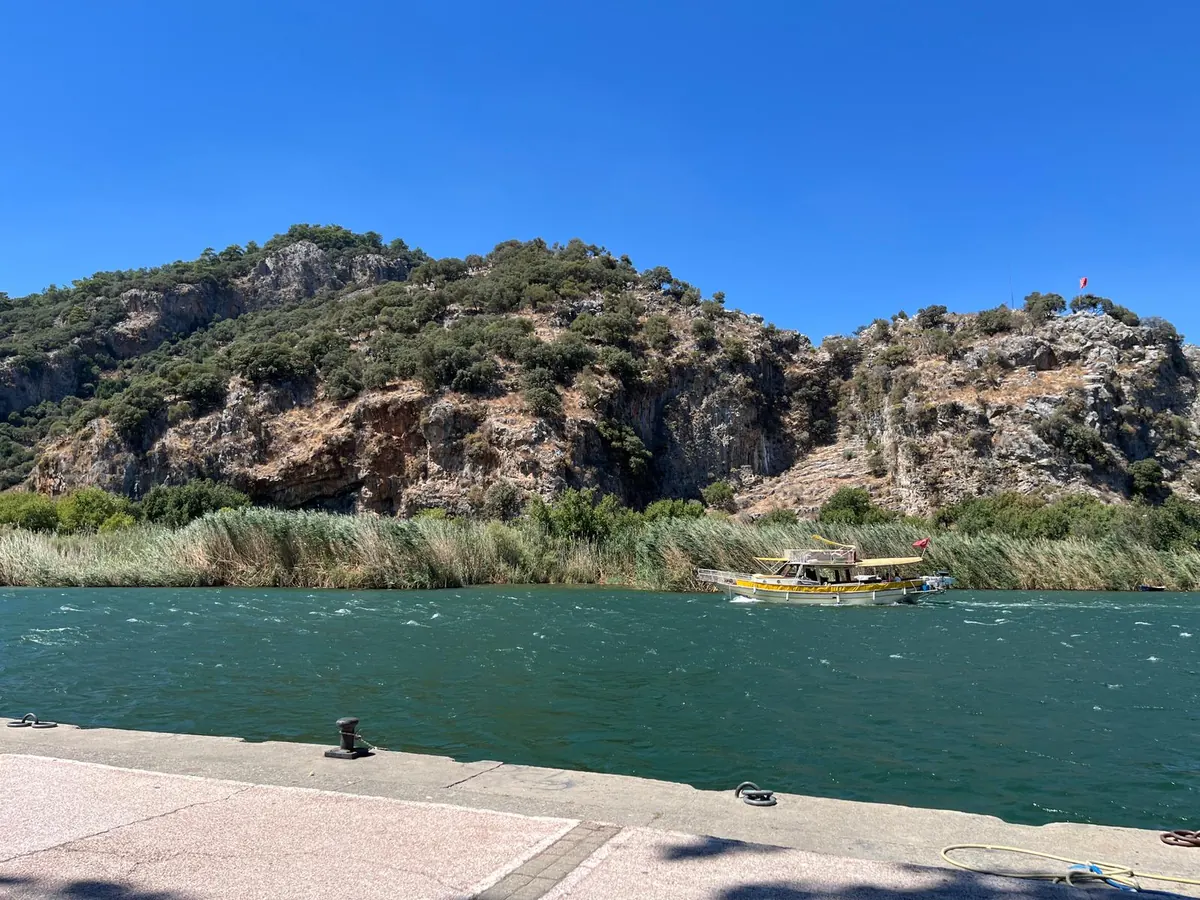
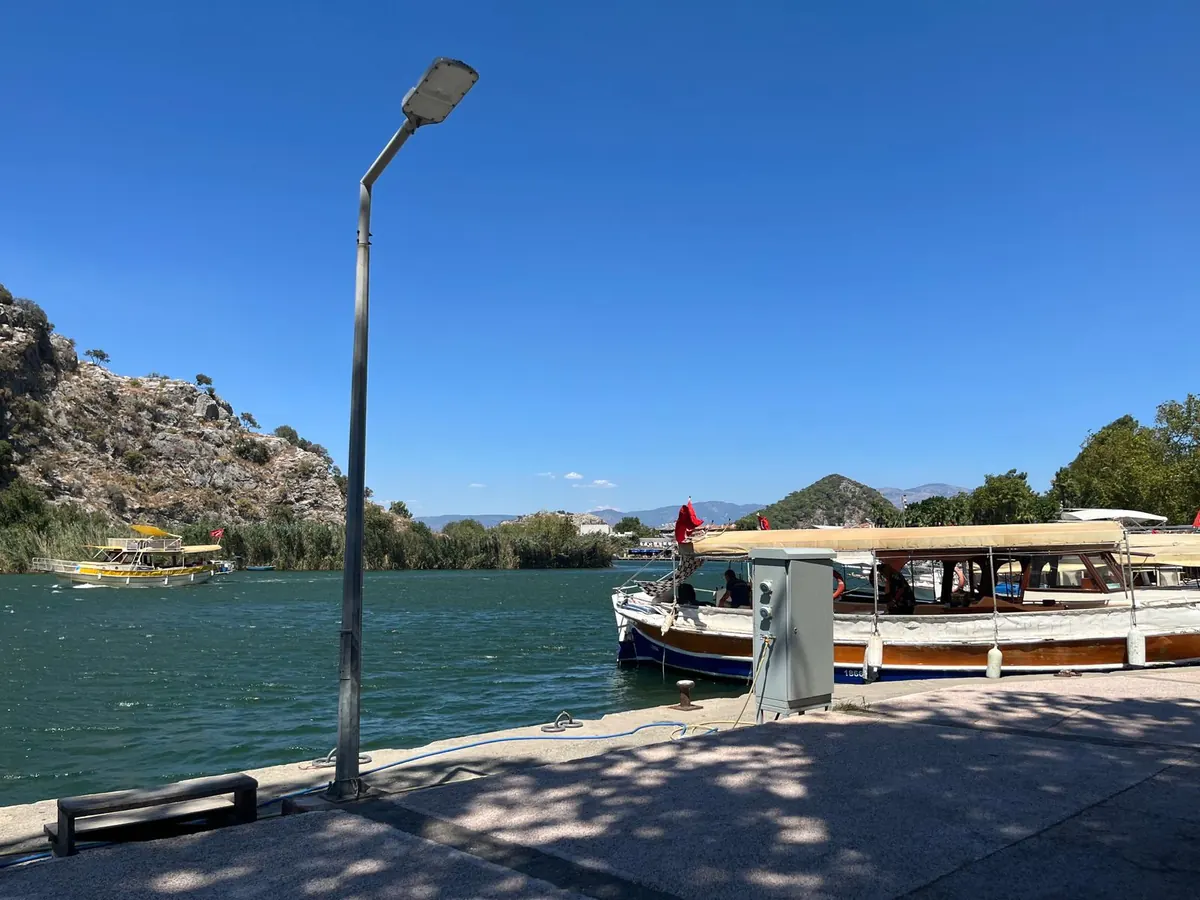
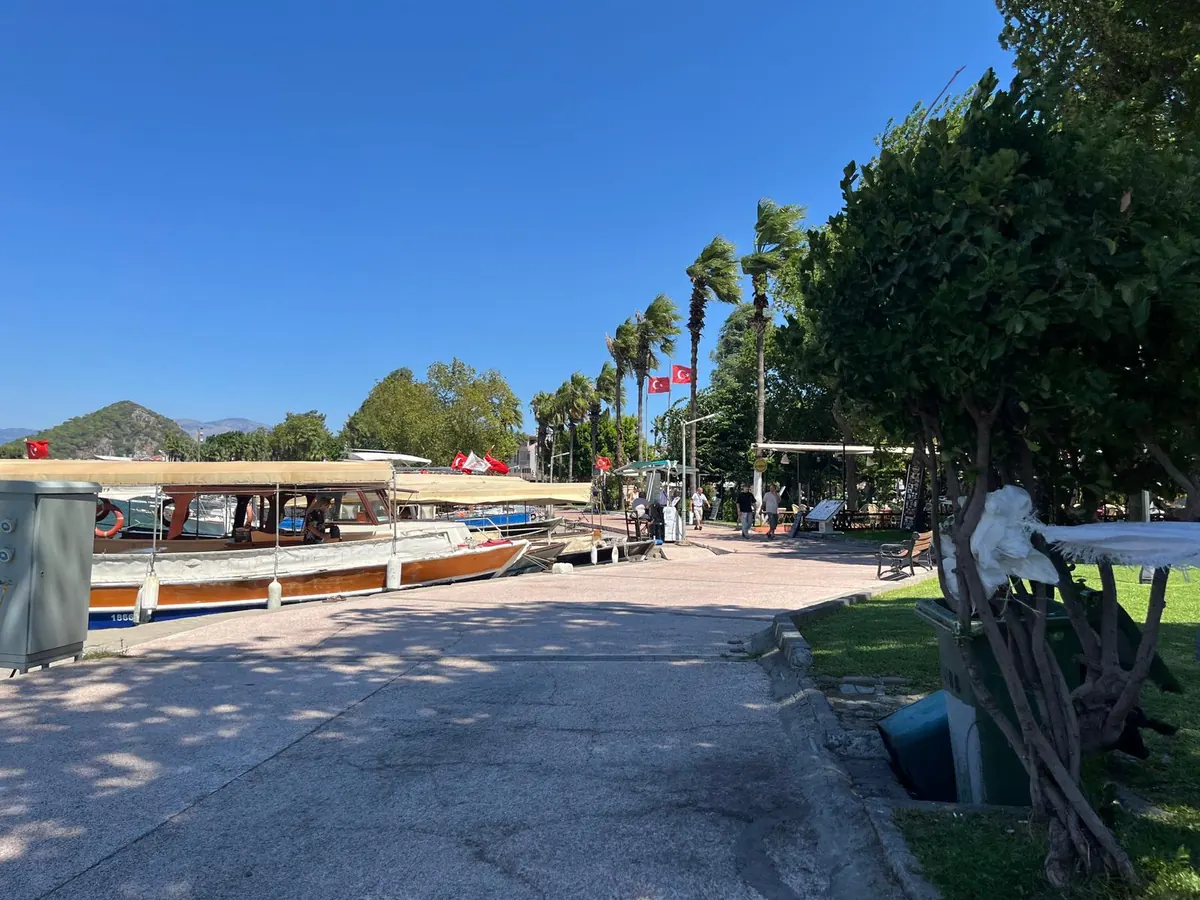
- 09:15 · Dalyan quay — the town is one street of restaurants along a green river, with the tombs staring back from the cliff opposite.
- 09:30 · The reed channels — reeds three metres tall on both sides, the channel narrowing until the boat almost brushes them, herons lifting off ahead of the bow.
- 10:15 · Sultaniye mud baths and hot springs — grey sulphur mud, dried in the sun until it cracks, rinsed off, then thermal water at around 39°C. Allow an hour.
- 11:45 · Köyceğiz Lake — a slow crossing of open water with the Taurus mountains behind it.
- 13:00 · Kaunos rock tombs — the boat holds position under the cliff so you can photograph the temple façades cut into the rock.
- 14:00 · İztuzu Beach — three to four hours of sand, swimming and the turtle rescue centre.
- 17:30 · Back at the Dalyan quay — usually with the light going gold on the tombs.
- 19:00 · Marmaris — dropped at the same door.
How much time do you actually get on İztuzu Turtle Beach?
Three to four hours is the right amount, and it is the single number worth asking about before you book anything. İztuzu is four and a half kilometres of sand between the river and the open Mediterranean, and an hour there is a photograph rather than a swim.
The arithmetic is unforgiving. A day trip from Marmaris spends about two hours and forty minutes on the road. Add the mud baths, the lake crossing and Kaunos, and whatever is left over is your beach time. On a coach day that also has to complete two hotel circuits, the leftover can shrink to ninety minutes.
Anyone who promises you the mud baths, Kaunos, the lake and the beach inside five hours is giving you forty minutes of sand and hoping you do not count.
What do you actually see on the Dalyan river boat?
Four things, and they are the reason the trip exists in this shape: the reed labyrinth, a sulphur spring used since antiquity, a cliff of 2,400-year-old rock tombs, and a protected nesting beach. They happen to sit along one river, which is why one boat can reach all of them.
The tombs belong to Kaunos, a Carian city cut in the Lycian style in the 4th century BC. They are full temple façades — columns, pediments, the lot — carved directly into the rock face. You cannot climb up to them, and they photograph best from the water, which is exactly where the boat stops.
İztuzu has been protected since 1988, after an international campaign stopped a hotel being built on the sandbar. Loggerhead turtles (Caretta caretta) nest there between May and September, the beach is closed at night in those months, and no vehicle goes on the sand. Those rules are the whole reason it still looks like this.
You will not see nesting turtles — nobody does, and that is the point. At the river end of the beach the DEKAMER rescue centre treats injured turtles and can be visited while you are there.
Is the coach excursion ever the better choice?
Yes, and it would be dishonest to pretend otherwise. Per head, a coach seat is the cheapest way to reach Dalyan from Marmaris, and for two people travelling on a tight budget that matters more than an extra hour at the beach.
The economics are the honest part of this. A private transfer is one vehicle whatever the number in it, so the cost per person falls sharply as the group grows. For a couple the gap against a coach seat is at its widest. For six or more it narrows a lot, and by then the private day is usually the sensible buy rather than the indulgent one.
The coach also suits people who genuinely enjoy the social side of a big group day, and people who mainly want to say they saw the tombs and stood in the mud. Both are perfectly good reasons.
Where the coach fails is narrower and easier to predict: small children on a 07:00 pick-up and a fixed return, anyone with limited mobility moving with fifty people, and anyone who came for the beach rather than the checklist.
What is included, and what do you pay for on the day?
The boat fare covers the boat: skipper, the whole route, tea and water on board. Entrance fees, lunch and sunbeds are separate almost everywhere on this coast, and they are paid where you use them.
The Kaunos ancient city entrance and the Sultaniye mud bath entrance are set by their own operators, not by the boat, and are collected at the gate in Turkish lira. The mud bath gate and the beach café do not take cards. Bring cash and the day is frictionless; arrive with only a card and you will spend the morning asking about ATMs.
Lunch is usually your choice between the beach café at İztuzu and food on board. Sunbeds and umbrellas at the beach are hired separately from whoever has them.
What a Dalyan day costs from Marmaris moves with the season, the size of the group and whether the boat is shared or private — which is why any page quoting one fixed figure for the whole year is guessing. Ask for the price for your dates and your numbers, and ask what is not in it.
What should you bring for a day trip from Marmaris?
Pack for a full day outdoors, not for an excursion, because you will be away from your hotel for about eleven hours. Two things catch people out every season: the sulphur and the sun on the deck.
- A swimsuit you do not love — sulphur gets into the fabric and does not come out.
- Towel and a dry change of clothes for the drive back.
- High-factor sun cream. The breeze on a boat deck hides how strong the sun is; almost every burn we see happened on a deck, not on a beach.
- Hat and sunglasses.
- Cash in Turkish lira for entrance fees, lunch and sunbeds.
- Water shoes if you own them, for the mud pool and the lake edge.
- No silver jewellery. The mud will strip it. Leave it at the hotel.
- A light layer for the road home — the delta cools quickly once the sun is down.
Can you get from Marmaris to Dalyan on your own?
Yes — by hire car, or by bus to Ortaca and a dolmuş for the last six kilometres. Both work, and both put the timing of your day into somebody else’s hands.
The bus route is the cheap one. Intercity coaches run along the D400 between Marmaris and Fethiye and stop at Ortaca, and dolmuşes cover the last six kilometres into Dalyan through the day. The problem is the 09:30 boat: you are matching a timetable you do not control at both ends of an eleven-hour day, and the last connection back matters far more than the first one out.
A hire car solves the timing and gives you the rest of the week too. If you take one, drive to Dalyan, park in the town, and walk down to the quay — in May, June or September you can usually get on a boat the same morning. In July and August that is a gamble worth removing in advance.
One thing a car does not solve: you can drive to the Ortaca end of İztuzu in about 25 minutes from Dalyan and park there, but you arrive at the far end from the café and the rescue centre, and you skip the delta entirely. The river is half of what you came for.
When is the best time of year to do this trip?
May, June, September and early October. Warm sea, bearable air, everything open, and boats that are not full — which on a day with 160 minutes of road built into it matters more than usual.
July and August regularly pass 35°C and the delta holds the heat. The trip still runs and thousands of people still enjoy it, but you are adding an hour and twenty minutes of road at each end of the hottest part of the day, and you will plan everything around shade.
April and late October are a gamble that often pays off: green hills, cool evenings, a sea that is bracing rather than warm, and some boats not yet open or already finished for the year. From November to March most of the tourist side of Dalyan is shut and the boat trip is not running at all.
One piece of ordering advice, whichever month you come: do not put this on your arrival day or your departure day. It is eleven hours with a flight either side of it, and the middle of your stay is where it belongs.