How far is Dalyan from Sarıgerme, and how long is the drive?
Dalyan is about 25 kilometres from Sarıgerme by road and the transfer takes 25 to 30 minutes, hotel door to boat quay. That makes Sarıgerme the closest resort of any size to the Dalyan delta.
The route is simple: out of the Sarıgerme valley to the D400 coast road, east past Dalaman, then through Ortaca and down the signposted turning to Dalyan. Ortaca is the last town before the river, six kilometres short of it. None of the road is mountain hairpins, which matters if anyone in the group travels badly.
For comparison, the same day out is roughly an hour each way from Fethiye and about an hour and twenty minutes from Marmaris. From Sarıgerme you spend under an hour in a vehicle for the whole day and the rest of it on water — which is why the trip works with small children from here and is hard work from further along the coast.
Pick-up is normally about forty minutes before the boat leaves the quay, so the morning does not start in the dark. We confirm the exact time the evening before.
Is there a boat that leaves from Sarıgerme beach?
No. There is no Dalyan boat departure from Sarıgerme itself, and any trip sold to you as one is a different product.
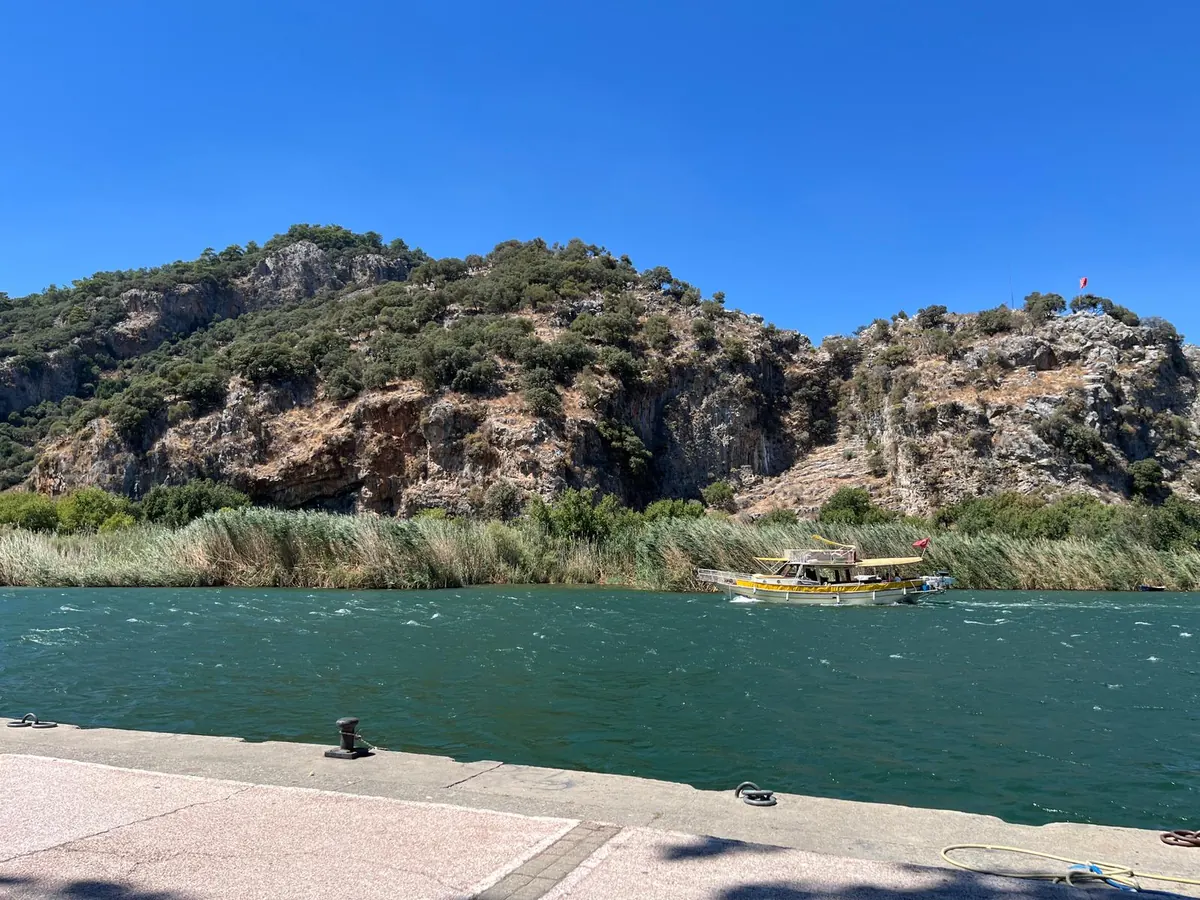
Sarıgerme faces the open Mediterranean across a long sand beach backed by pine, with no river mouth, no delta channel and no working harbour. Every boat that visits the mud baths, the rock tombs and İztuzu leaves from the town quay in Dalyan, five kilometres up a river from the sea, and those boats are built for flat inland water rather than the coast. They do not come to collect you.
So a Dalyan boat trip from Sarıgerme hotels is always the same two-part shape: a short road transfer, then the boat. That is simply where the river is.
If somebody offers you a boat leaving from Sarıgerme sand, ask what is on the itinerary. It will be a coastal sea trip — pleasant, but with no reed channels, no thermal mud and no tombs.
Half day or full day: which one suits your family?
Take the full day if your children are over about five and used to a long day out. Take the half day if they still nap in the afternoon, burn easily, or you have a fixed dinner sitting at the hotel you would rather not miss.
The full day is roughly eight hours on the water plus the two short drives — call it nine and a half hours door to door. It is the version that fits everything in without rushing, including three to four hours on İztuzu.
The half day is about four hours on the water and five door to door, which gets you back to Sarıgerme in the early afternoon with the pool still ahead of you. Be clear about what it costs you, though. Something is always cut, and it is usually the beach: İztuzu drops to under an hour or disappears from the itinerary, or the mud baths get skipped instead.
"Half-day Dalyan tour" is not a fixed product with an agreed meaning, so ask the specific question before you book anything, from us or from anyone else: how long do we actually get at İztuzu? A trip promising the mud baths, Kaunos, the lake and the beach in four hours is giving you forty minutes of sand.
With very young children there is a third option. A private boat leaves when your group is ready rather than at half past nine and comes back when the youngest has had enough. For a family of six or more it is often closer in cost to the shared trip than people expect.
What does the full-day excursion from Sarıgerme cover?
The full day covers the four things Dalyan is known for — the reed channels, the Sultaniye mud baths, the Kaunos rock tombs and İztuzu Beach — with the road transfer from your Sarıgerme hotel at each end.
The order is the standard one for a practical reason: mud in the morning while the sun is strong enough to bake it, the beach in the afternoon when the sea is warmest.
- Hotel pick-up in Sarıgerme and about 25 to 30 minutes by road to the Dalyan quay.
- The reed channels — the first twenty minutes out of town, with reeds three metres tall on both sides and herons lifting off ahead of the bow.
- Sultaniye hot springs and mud baths on the far shore of Köyceğiz Lake: grey sulphur mud, dried in the sun until it cracks, then a thermal pool at around 39°C. Allow an hour.
- Köyceğiz Lake — a slow open crossing with the Taurus mountains behind it, and tea served on board.
- The Kaunos rock tombs, photographed from the water. Temple façades with columns and pediments, cut straight into the cliff in the 4th century BC by a Carian city that built in the Lycian style.
- İztuzu Beach — three to four hours on four and a half kilometres of protected sand, with a café, showers and the turtle rescue centre at the river end.
- Back up the river to Dalyan, then the same minibus to the same door in Sarıgerme.
Is the Dalyan boat trip suitable for young children?
Yes, unusually so, because the entire day is flat water. There is no open sea, no swell and no crossing that can turn uncomfortable if the wind gets up in the afternoon.
The boats have a covered section, rails all the way round and a WC, and they move at the speed of a river rather than a speedboat. İztuzu shelves gently on the river side, where families sit, and the beach is wide enough that a child can run in a straight line for a long time without meeting anybody.
The honest limitations are worth knowing. There is no baby-changing anything on board, the boarding ladders are steep for small feet, and a pushchair is a nuisance on a wooden deck and useless on sand — a carrier is far better. Toddlers who will not keep a hat on struggle most, because the breeze on deck hides how strong the sun is. Every sunburn we see happened on a boat, not on a beach.
Tell us the ages when you book. Boats differ in how much shade they carry and how the deck is laid out, and putting a family with a two-year-old on the right one changes the whole day.
What are the mud baths actually like with children?
Children from about four upwards usually think the mud baths are the best hour of the holiday; children under two usually do not. It is warm, it smells strongly of sulphur, and you end up completely covered.
The routine takes around an hour: coat yourself in grey mud from the pool, stand in the sun until it dries and cracks, rinse it off in the wash pool, then sit in the thermal water at around 39°C. The spring has been used since antiquity and is hot enough that small children should stay in the cooler wash pool.
Three practical warnings. The sulphur smell goes into swimwear and does not come out, so bring an old swimsuit rather than the new one. The mud blackens silver, so rings and chains stay on the boat. And the entrance fee at Sultaniye is charged at the gate by the site itself, in lira cash, separately from the boat.
If someone would rather not do it at all, that is fine and fairly common. The boat waits, there is shade and a café, and nobody has to be talked into standing in sulphur.
Will we see loggerhead turtles at İztuzu Beach?
You may well see adult loggerheads surfacing near the river mouth, particularly by the fishing weirs, but you will not see nesting or hatchlings on a day trip, and nobody honest will promise you either.
Caretta caretta nest on İztuzu between May and September. During those months the beach is closed at night, umbrellas must stay behind a marked line and no vehicle goes on the sand. Those rules are the entire reason the beach still looks the way it does — it has been protected since 1988, after an international campaign stopped a hotel being built on it.
What you can reliably do is visit the sea turtle rescue centre at the river end of the beach, where injured animals are treated and can be seen up close. It is a five-minute walk from where the boats tie up, and it is the part of the day most children remember afterwards. A sighting from the boat is luck; the rescue centre is a certainty.
When is the best time to do this excursion from Sarıgerme?
May, June, September and early October are the best weeks for the Sarıgerme to Dalyan excursion: warm sea, air you can stand at midday, everything open and boats that are not full.
July and August are hot — regularly over 35°C — and the delta holds the heat, with reeds on both sides cutting off what breeze there is. The trip still runs daily and thousands of people enjoy it, but you plan the day around shade, and two in the afternoon on an open deck is the hottest hour of your holiday. In high summer with small children, take the earliest departure or take the half day.
April and late October can be excellent and can be a gamble. The hills are green and the boats are quiet, but the sea is bracing rather than warm and some places have not opened or have already closed.
Between November and March the question barely arises, because most Sarıgerme hotels are seasonal and closed. Dalyan carries on as an ordinary Turkish town in winter — beautiful, wet and largely shut for tourism.
What to bring when you leave an all-inclusive hotel for the day
The single thing people forget is cash, because an all-inclusive wristband stops working at the hotel gate. Site entrance fees, the mud baths, lunch, drinks off the boat and sunbeds at İztuzu are all paid locally in lira, and several do not take cards.
Beyond that the packing list is short, and most of it is about sun rather than water.
- Cash in lira — for the mud bath entrance, the Kaunos site fee if you land, lunch and sunbeds.
- An old swimsuit for the mud, plus a second one you actually like for the beach.
- Towels — hotel pool towels often may not leave the property, so check at reception rather than at the gate.
- High-factor sun cream, a hat that stays on, and sunglasses.
- A change of clothes for everyone, packed dry in a bag.
- Water shoes if you have them, for the mud pool and the stones at the wash-off point.
- Silver jewellery left in the safe, not worn — the mud blackens it.
- Any allergy or dietary requirement told to us the day before, not mentioned on the boat at lunchtime.
How pick-up, inclusions and payment work from Sarıgerme
You are collected from your hotel in Sarıgerme and returned to the same door, and the road transfer is part of the excursion rather than something you arrange separately. Nobody should be asking you to find your own way to the quay.
Normally included: the transfer both ways, the boat and its licensed skipper, tea and water on board, and crew who speak English and Turkish. Normally not included, and paid in cash on the day: the mud bath entrance, the fee if you land at the ancient city of Kaunos, lunch, and sunbeds. Ask for that split in writing before you commit, whoever you book with — the gap between a cheap-looking price and a fair one usually hides in that list.
Prices vary with the season, the group size and whether the boat is shared or private, so any site quoting a single figure for the whole year is guessing. Message us with your dates and numbers and you get the real one.
Your hotel excursion desk will sell you something similar, and comparing is sensible. Ask both of us the same two questions: how many hours do we get at İztuzu, and how many people are on the boat. The answers tell you more than anything else on the leaflet.