Where can you actually see Caretta Caretta in Dalyan?
The most reliable place to see a loggerhead in Dalyan is the river, not the beach. Adult turtles come in from the Mediterranean and work their way up the channel to feed, and the stretch between İztuzu and the fishing weirs below town is where they spend the day.
The weirs are the reason. Dalyan means fishing weir, the wooden traps still cross the channel, and they concentrate fish; where the fish are, the turtles follow. Add the restaurant jetties in town, where scraps end up in the water, and you have a few kilometres of river holding more turtles than the coast outside.
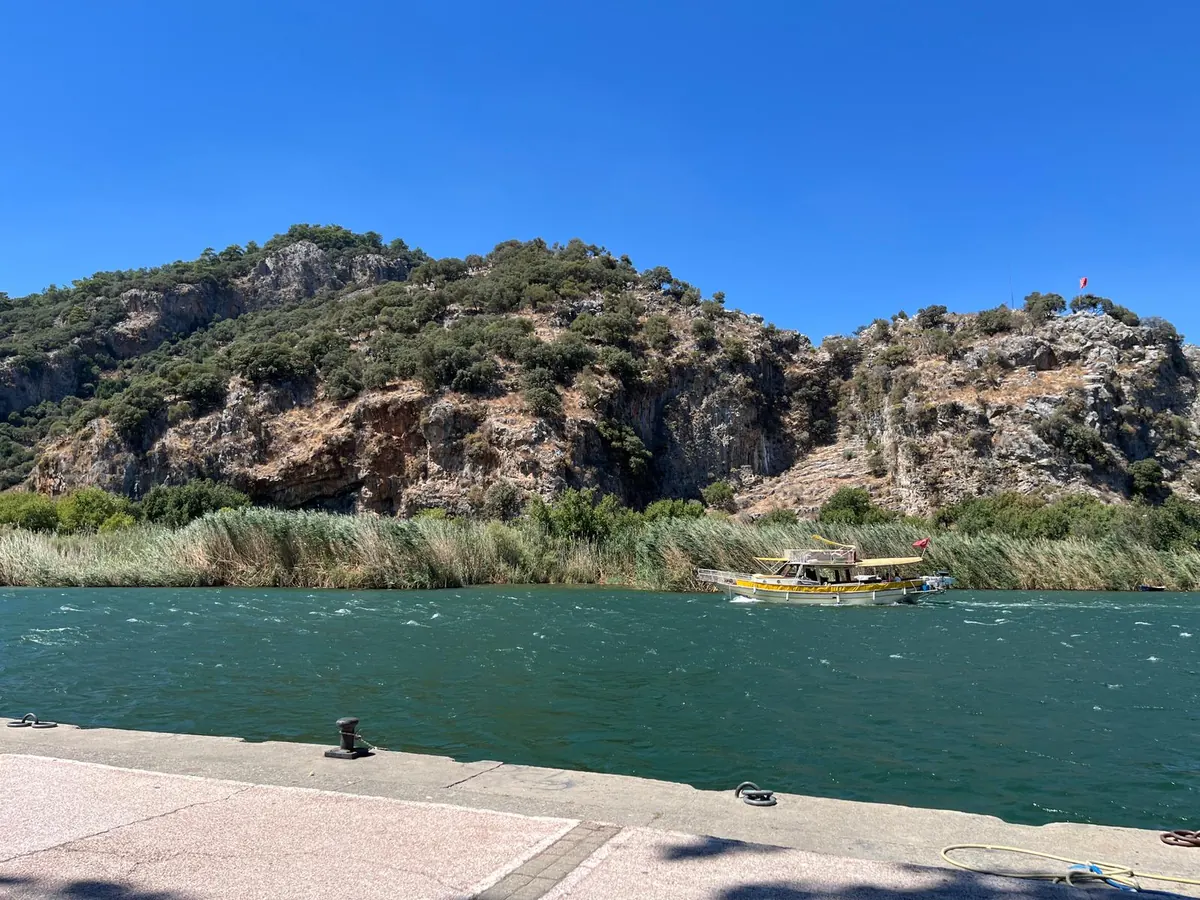
You do not need a boat for this. The river path through town and the terraces above the water look straight down onto the channel, and on a still morning you can stand in one spot for twenty minutes and see three or four heads come up.
These are the places we look, in rough order of how often it works.
- The weirs below town — the wooden fish traps the place is named after. The single most dependable spot on the river.
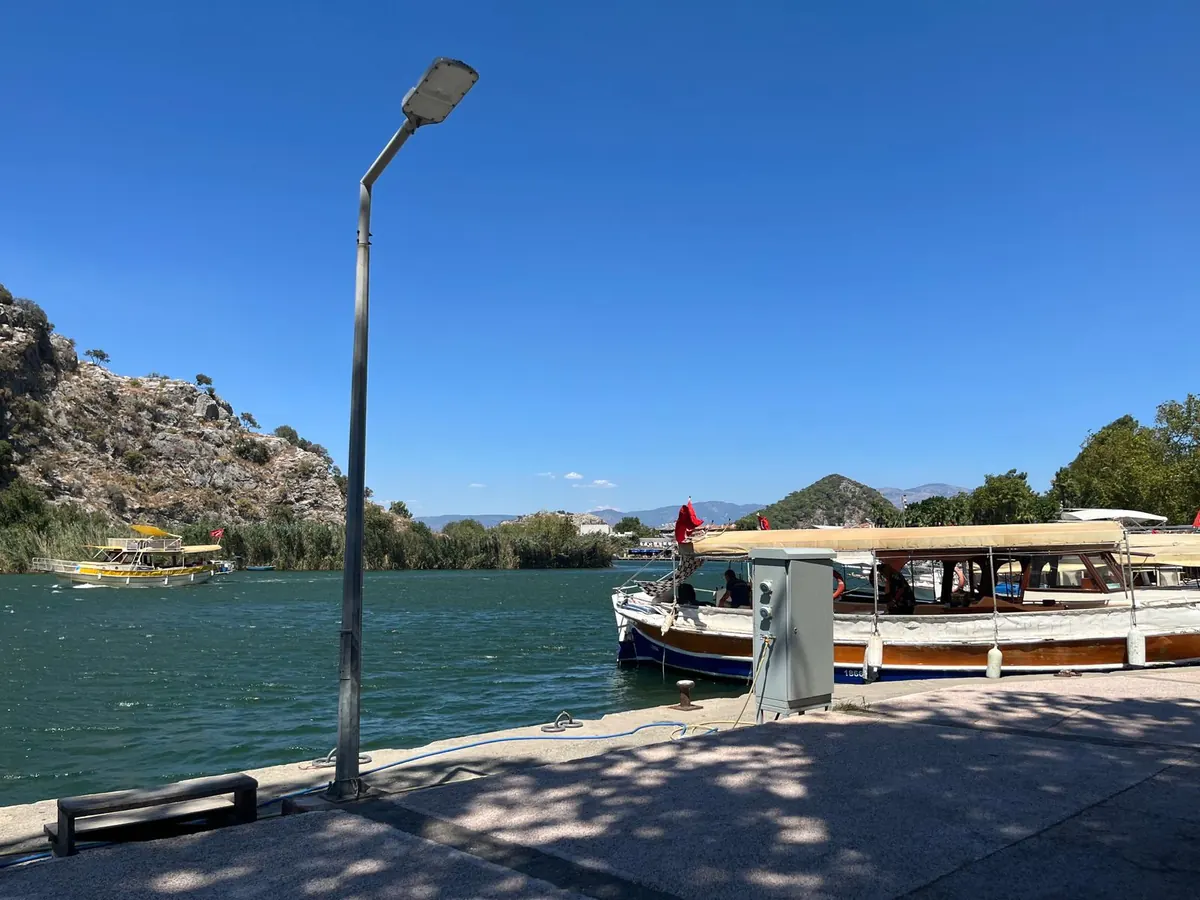
- The channel in front of the town jetties, seen from the river path or a terrace above it. No boat, no ticket, no plan needed.
- The wide bend beneath the Kaunos rock tombs, where the current slows and boats are usually holding position anyway.
- The last kilometre before İztuzu, where the river meets the sea and the water clears enough to show the shell as well as the head.
- The river mouth at the İztuzu end of the beach, watched from the sand rather than from a boat.
What time of day gives you the best chance?
Early morning and the last two hours before dark are far better than the middle of the day. The shared boats leave the quay around half past nine and are back around half past five; between those hours dozens of engines are working the same channel and the turtles simply stay down.
Between roughly seven and nine in the morning the river is glass. A loggerhead surfacing to breathe makes a small, distinct blip and a spreading ring of ripples — on flat water you catch it from fifty metres away, and in a light chop you will miss it from ten.
The evening window works for the same reason and adds the light. From about half past five the boats are tied up, the delta goes quiet and the cliff opposite turns orange. That is why an evening cruise is quietly one of the better turtle trips in Dalyan, even though nobody sells it that way.
Season matters more than the hour. River sightings run from roughly April to November and peak from May to October. In winter the animals move out to deeper water offshore, feed less and surface less; you can spend a week here in January and see nothing at all.
What a loggerhead looks like from a boat — and what it is not
You see the head first, and usually only the head: a blunt, reddish-brown wedge about the size of a grapefruit, up for two or three seconds, then gone with barely a splash.
The Dalyan river carries silt down from Köyceğiz Lake and runs green rather than clear, so the body below stays invisible. An adult here is roughly 70 to 90 centimetres of shell and can weigh 70 kilos or more — a genuinely large animal — and you will see none of it until one turns and a front flipper breaks the surface.
Two things get mistaken for sea turtles. The small dark shapes basking on logs and mud banks along the quieter channels are freshwater terrapins, palm-sized to dinner-plate-sized, and a different animal entirely. Cormorants surfacing after a dive also make a head-shaped blip, but a cormorant stays up and a turtle does not.
Practically everything you will see here is a loggerhead. Green turtles do live in the Mediterranean, but they nest mainly along Türkiye’s eastern coast and are rare this far west.
Once you have seen a few, start looking at the shells. Notches, healed cracks and missing flipper tips are common, and most of them come from boat strikes and fishing gear. The research team at the beach photographs and identifies individual turtles by exactly those marks.
Are there sea turtles on İztuzu beach itself?
Yes — but almost entirely at night, and almost entirely out of sight. What you see on İztuzu by day are the nests, marked out on the dry sand, rather than the animals that made them.
İztuzu is four and a half kilometres of sand sealing the river off from the Mediterranean, protected since 1988. Females haul out after dark between May and September, drag themselves past the high-water line, dig a chamber with their back flippers, lay a clutch of roughly seventy to a hundred and twenty eggs, cover it and go back to the sea. The whole business takes an hour or two and leaves a track up the beach like a narrow tractor tyre.
Each morning in season a monitoring team walks the beach, reads the night’s tracks, locates the nests and marks them. That is the wire cage or the grid of stakes you will walk past on the upper sand, and it is there to keep foxes, dogs and feet off the eggs. Do not sit on them, lean on them or let a child climb them.
Incubation takes roughly seven to nine weeks. Sand temperature decides the sex of the hatchlings — warmer sand produces more females — which is one reason nobody is allowed to change the shade, the profile or the vegetation line of the upper beach. Hatchlings emerge at night from about July to early October and run towards the brightest horizon, which on an unlit beach is the sea.
In the water, the place turtles come closest to swimmers is the river end, where the channel meets the open sea and the water clears. Sit on the sand there for half an hour in the early evening and you have a fair chance of a head twenty metres out.
The rules: do not feed, do not touch, do not chase
The most damaging thing a visitor does in Dalyan is feed the turtles — usually from a jetty, usually with a fish bought for the purpose, and almost always meaning well.
A wild loggerhead that learns boats and jetties mean food stops foraging and starts waiting. It spends its day in the busiest, shallowest, most propeller-heavy water in the delta, and it approaches hulls instead of avoiding them. Look at the tanks at the rescue centre down at the beach: a large share of the patients are there because of a boat strike or swallowed fishing tackle.
The rest is simpler than it sounds. Give them room, keep your hands to yourself, and leave the beach the way you found it.
None of this is decoration. Caretta caretta is protected under Turkish law and under international convention, the whole delta is a Specially Protected Area, and the wardens on İztuzu enforce the beach rules.
- Do not feed them, and do not buy fish to feed them. A turtle that learns boats mean food spends its life among propellers.
- Do not touch, hold, ride or lift one, in the water or out of it.
- Give at least five metres in the water and let the turtle choose the distance. Never put yourself between a turtle and open water.
- No flash photography, and no drones low over the river or the beach.
- Keep umbrellas behind the marked line at İztuzu. An umbrella spike driven into a nest ends it.
- Fill in every hole you dig and flatten sandcastles before you leave. A hatchling that drops into a hole in the dark does not climb out.
- Take everything off the sand in the evening — bags, toys, inflatables, chairs. Anything left behind is an obstacle on a beach used at night.
- If you find an injured or stranded turtle, do not push it back into the water. Note where it is and tell the beach staff or the rescue centre.
Why does İztuzu beach close at night?
Because nesting happens after dark, and a female disturbed on her way up the sand will usually turn around and go back to the sea without laying.
In nesting season the sand clears in the evening and stays closed overnight. The exact times are posted at the entrances and move through the summer as sunset shifts. There is no lighting on the beach and no building behind it, which is the second half of the same rule: hatchlings navigate towards the brightest horizon, and a single lit terrace behind the dunes can pull an entire night’s emergence inland instead of out to sea.
This is also why İztuzu looks the way it does. In the late 1980s a hotel was planned for the sandbar, and an international campaign stopped it — led on the ground by a British woman who lived in a wooden hut on the beach and was known to everyone here as Kaptan June. The beach was protected in 1988. No hotel, no road along the sand, no bar, no lights.
The trade is worth stating honestly, because visitors are sometimes disappointed by it: the rules that keep İztuzu empty are the same rules that stop you watching a turtle nest. The beach still exists because nobody is allowed to watch.
What is DEKAMER, and is it worth visiting?
DEKAMER is the sea turtle research, rescue and rehabilitation centre at the river end of İztuzu, and it is the only place in Dalyan where you can look at a loggerhead close up without disturbing a wild one.
It is a working clinic rather than an attraction, and it reads like one. The turtles in the tanks are patients — propeller injuries, hooks and monofilament line, swallowed plastic, entanglement in net. Most have a board explaining where they were found and what happened to them, and some are missing a flipper and will never be released.
The same team runs the nest monitoring along the four and a half kilometres of beach: walking it at first light through the season, recording tracks, marking nests, and afterwards excavating them to count how many eggs actually hatched. The stakes and signs on the sand are the visible end of that work.
Practically: the shuttle boats from Dalyan land at the river end of the beach, which is the end the centre is on, a short walk from the café and the showers. Arriving by road puts you at the opposite end of four and a half kilometres of sand, so the boat is the sensible way in. It is open to visitors through the season, hours are posted at the gate, and it runs largely on donations — take some cash with you.
What you will not see, honestly
You will not see a turtle nesting, and you will not see hatchlings run for the sea. Both happen at night on a beach that is closed at night, and there is no version of the trip — private boat, extra payment, friend of a friend — that puts you on that sand after dark.
If somebody offers you a hatchling-release tour in Dalyan, they are offering something that is not permitted. Rehabilitated turtles are released when they are medically ready, sometimes in front of whoever happens to be there, but it is not a scheduled event and it cannot be booked in advance.
What is realistic is better than most people expect: adult loggerheads in the river at close range, several times over a day on the water; marked nests on the upper beach from June onwards; and turtles under treatment at the rescue centre.
Bring binoculars if anyone in the group cares about wildlife — nothing else improves a river day so cheaply. And if you are travelling with children who will be let down by a two-second glimpse, put the turtle-spotting into a quiet early morning rather than making it the point of a busy midday boat.