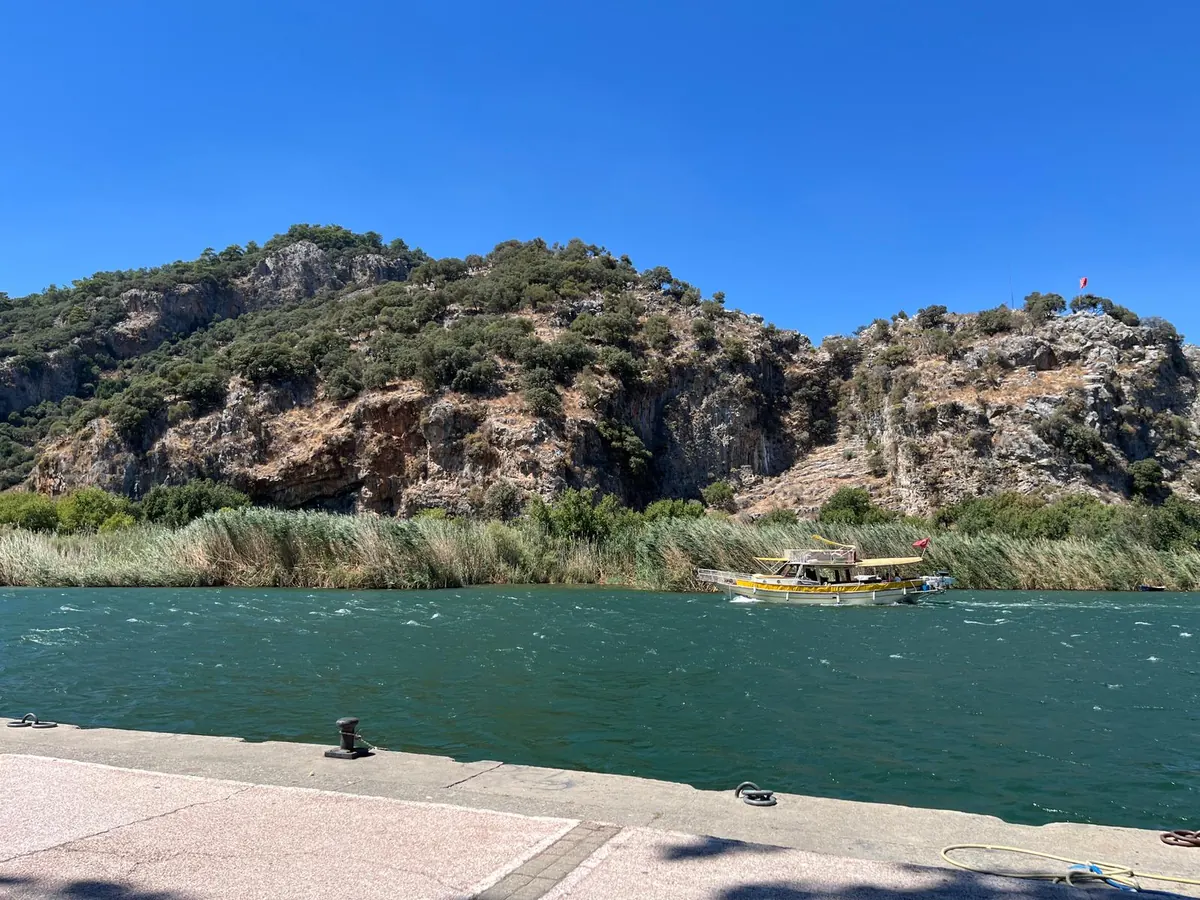
Is a Dalyan boat trip actually good for children?
Yes, with one condition: that the adults understand what they have booked. A Dalyan boat trip is a slow river journey with four or five stops spread across a day. The water is flat — this is a river and a lake, not open sea — so seasickness is rarely the problem it is on a Mediterranean day boat. Boats move at walking pace through the reed channels. Nobody is being thrown around.
What makes it work for children is the shape of the day. It is not one long crossing; it is a series of arrivals. You get off at the mud baths. You look up at the tombs. You spend hours at a beach. Between those, there are gaps of half an hour or so on the move, and that is where the patience of a six-year-old gets tested.
What makes it not work is expecting the boat to occupy them. There is no kids’ club, no screen, and often no reliable signal in the middle of the delta. Families who bring something for the in-between stretches — a book, cards, a drawing pad, binoculars for the birds — have a completely different day from families who do not.
The delta itself does a lot of the work, though. There are terrapins, herons, the odd loggerhead surfacing beside the boat, and channels so narrow the reeds brush the sides. Most children find that more interesting than they expect to.
Which ages cope with the full day, and which do not
There is no rule and no minimum age on the river, but there are clear patterns, and it is more useful to be honest about them than to tell every family the trip is perfect.
- Babies and children under about two. Manageable, but the day is built around adults. There is no baby-changing space on board, shade is limited, and naps happen where they happen. Many families with a baby take a shorter run to the beach instead.
- Roughly three to five. The hardest bracket. Old enough to be bored, not always old enough to be interested. Works well on a private boat where you control the timings; harder on a shared full day.
- Roughly six to eleven. The sweet spot. Mud baths are the best thing that has ever happened to them, the tombs are properly impressive, and four hours on a beach is not too long.
- Teenagers. Fine, provided they are told in advance that phone signal comes and goes. The swimming stops and the beach carry the day.
Mixed-age groups are the common case and usually the easiest, because older children absorb the younger ones. A ten-year-old with a four-year-old sibling will keep that sibling busy through the flat parts more effectively than any adult plan.
What the day looks like with children on board
Boats leave the Dalyan town quay in the morning. The first twenty minutes are the reed channels, and this is reliably the best part with children — the boat is close to the banks, there are birds constantly, and the channels are narrow enough to feel like an adventure rather than a view.
Then the boat crosses open water towards the Sultaniye springs. This is the first flat stretch, roughly half an hour of not much happening. It is also, in practice, when small children ask how long is left for the first time.
The mud baths break the day open. After that there is a slow crossing of Köyceğiz Lake with the mountains behind it, tea on board, and the second quiet stretch. Then the Kaunos rock tombs, viewed from the water, which impresses children more than you would expect because the scale is obvious from below.
İztuzu is the back half of the day, and it is long — three to four hours. For families this is the point of the whole trip rather than the last stop. The full route, stop by stop, is set out in our complete guide to the Dalyan boat trip if you want the detail.
The boat itself: shade, space and what is not there
Dalyan tour boats are wooden day boats, typically with a covered section and an open sun deck. Children can move around while the boat is under way, which is a large part of why the day is bearable for them — they are not strapped into a seat for eight hours.
Shade is real but finite, and it is shared. On a busy shared boat in July, the covered seats fill first. If you have a baby or a child who genuinely cannot be in the sun for long stretches, that is worth saying when you book rather than discovering on the jetty.
Facilities vary from boat to boat, and this is the honest bit: do not assume. Whether there is a toilet on board, what size life jackets are carried, whether there is a fridge for milk — ask about the specific boat you are booked on. We would rather answer that in a message beforehand than have you find out at nine in the morning.
What is definitely not on board: baby-changing facilities, a shop, and anywhere quiet and dark for a nap. Plan around those three and most of the practical problems disappear.
The mud baths with children: the best bit and the tricky bit
The Sultaniye mud baths are, for most children between about five and twelve, the highlight of their holiday. You are supposed to get filthy. Adults are covered in grey mud, drying in the sun and looking ridiculous. There is no version of this that a child dislikes.
The tricky part is the thermal pool that follows. The spring water is hot and heavily sulphurous — it smells strongly, and the temperature is more than some young children want. Nobody has to go in. Plenty of families do the mud, rinse off and skip the hot pool entirely, and that is a perfectly normal way to do it.
Two practical points. First, the mud stains light-coloured swimwear, so put children in something dark or something you do not mind losing. Second, keep it out of eyes — it stings, and the rinse-off area is busy. A small bottle of clean water in your bag solves the one problem that reliably causes tears here.
In April, May and October the hot pool is much more appealing to everyone, because the air is cooler. In August, most children want the mud and then the sea.
İztuzu with children: the two sides of the beach
İztuzu is a long sandbar with the sea on one side and the river mouth on the other, and for families that geography is the single most useful thing to know about it.
The sea side has small waves and shelves away more quickly. The river side is calmer, shallower and warmer, and it is where most families with young children end up. You can walk between them in a couple of minutes. If you arrive and the sea side looks livelier than you want, cross over.
The beach is a protected loggerhead nesting site, which shapes the rules rather than restricting the day: stay off the marked nest areas, do not dig where it is fenced, and take everything away with you. Children generally take this more seriously than adults once they know why. Our guide to the loggerheads explains what the markers mean.
Three to four hours is a long time on a beach with a toddler and no shade of your own. There are sunbeds and umbrellas near the main entrance, and there is a stretch further along with nothing at all. Decide which you want before you walk off with the buggy.
Feeding children on a boat day
Lunch on a Dalyan boat trip is usually served on board or taken at the beach, and it is straightforward Turkish food — grilled fish or chicken, salad, bread, rice. It is not a children’s menu, and fussy eaters can find it a stretch.
The fix is simple and nobody minds: bring what your children will actually eat. Boats have no objection to families bringing snacks, and the gap between breakfast and lunch is long enough that you will want them regardless.
Water is the thing families most often underestimate. On a hot day, children go through far more than you plan for, and the boat is not a shop. Bring more than seems sensible, and freeze a bottle overnight so it is still cold at İztuzu.
If anyone in the group has a genuine allergy or needs a vegetarian plate, tell us when you book, not on the morning. It is easy to arrange in advance and awkward to arrange at eleven o’clock on the water. If you are eating in town before or after, the riverside breakfast places are the easiest family option in Dalyan.
Safety, honestly
The river is calm and the boats are slow, which removes most of what people worry about. The realistic risks on a family boat day in Dalyan are sun, dehydration and unsupervised swimming — in that order — not the boat.
Sun is the big one. Eight hours of reflected light off water is not the same as eight hours by a pool. Hats, long-sleeved rash vests for younger children and reapplied sun cream do more for the day than anything else on this page.
On swimming: the boat stops in open water at points, and children should be in the water with an adult, not near the swim ladder alone. Most Dalyan boats carry life jackets, but child sizes are not guaranteed on every boat — if your child needs one that fits, ask us before the day rather than assuming.
The last one is boarding and disembarking. Getting on and off at the jetties, and at the mud baths, is the moment small children need a hand held. It is a short step, but it is over water and often onto a wet surface.
If the full day is too much: the shorter options
A lot of families would have a better time on a shorter trip, and we would rather say so than sell the long one to everyone.
The direct boat to İztuzu is the obvious alternative. It skips the mud baths and the lake crossing, takes you down the river to the beach, and brings you back when you want to come back. For families with children under about five, this is usually the better day: all of the river, all of the beach, none of the long middle.
The sunset cruise is the other one worth knowing about. It is short, it is the coolest part of the day in high summer, and children who would never sit still for eight hours are perfectly happy for ninety minutes with the light changing over the reeds.
You can also do both across two days — the beach boat on one, the evening run on another — and see more of the delta than the full day covers, in pieces small enough for young children. All the options that run from the quay are listed on our boat trips page.
When a private boat is worth it for a family
On a shared boat you keep the group’s timings. That is fine for most families and it is how the great majority of people do the trip. But there are three situations where a private boat changes the day enough to be worth considering.
- Young children who nap. On your own boat you can leave later, cut a stop, or sit somewhere quiet for an hour without asking twenty other people.
- Large family groups. Once you are six or more, you are close to filling a small boat anyway, and you stop having to split across the deck.
- July and August. The shared boats and the jetties are at their busiest, and setting your own hours is worth more in those weeks than at any other point in the season.
The trade-offs — what you gain, what you give up, and who it genuinely suits — are set out properly in our guide to shared versus private trips in Dalyan, and what is and is not included is explained in the guide to what a Dalyan boat trip costs and why.
Whichever you choose, tell us the ages of the children when you message. It changes what we recommend more than any other single detail, and it is the difference between a day your family remembers and a day they endure.