Where should you stay in Dalyan — Maras or Gulpinar?
Stay on the Maras side if walking to dinner matters more than swimming at home, and on the Gulpinar side if it is the other way round. That settles it for most groups, and everything below is the detail behind it.
On paper Dalyan is two neighbourhoods, Maras Mahallesi and Gulpinar Mahallesi. On the ground the administrative line matters less than the geography it follows: Dalyan is flat along the river and steep behind it. The level strip holds the jetty, the mosque, the market square and the restaurant row facing the rock tombs. The slope above it is where people live.
The small hotels are on the flat because that is where buildings already stood before anyone came here on holiday. The villas are on the slope because a private pool needs a plot, and plots exist behind the town rather than on it.
The furthest villas we work with are ten to twenty minutes on foot from the river — not far in May, a different sentence in August at eleven at night going the other way, uphill.
What is the riverside side of Dalyan actually like to stay in?
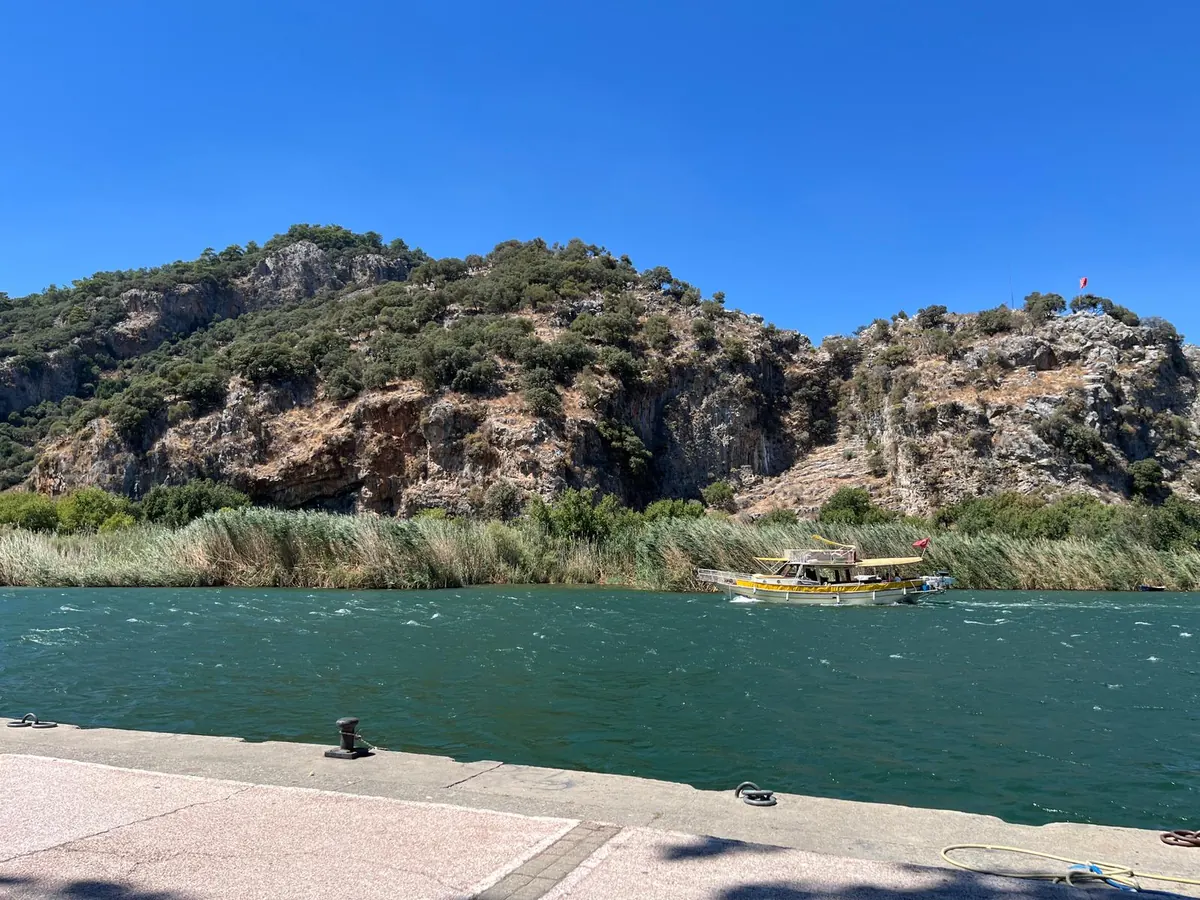
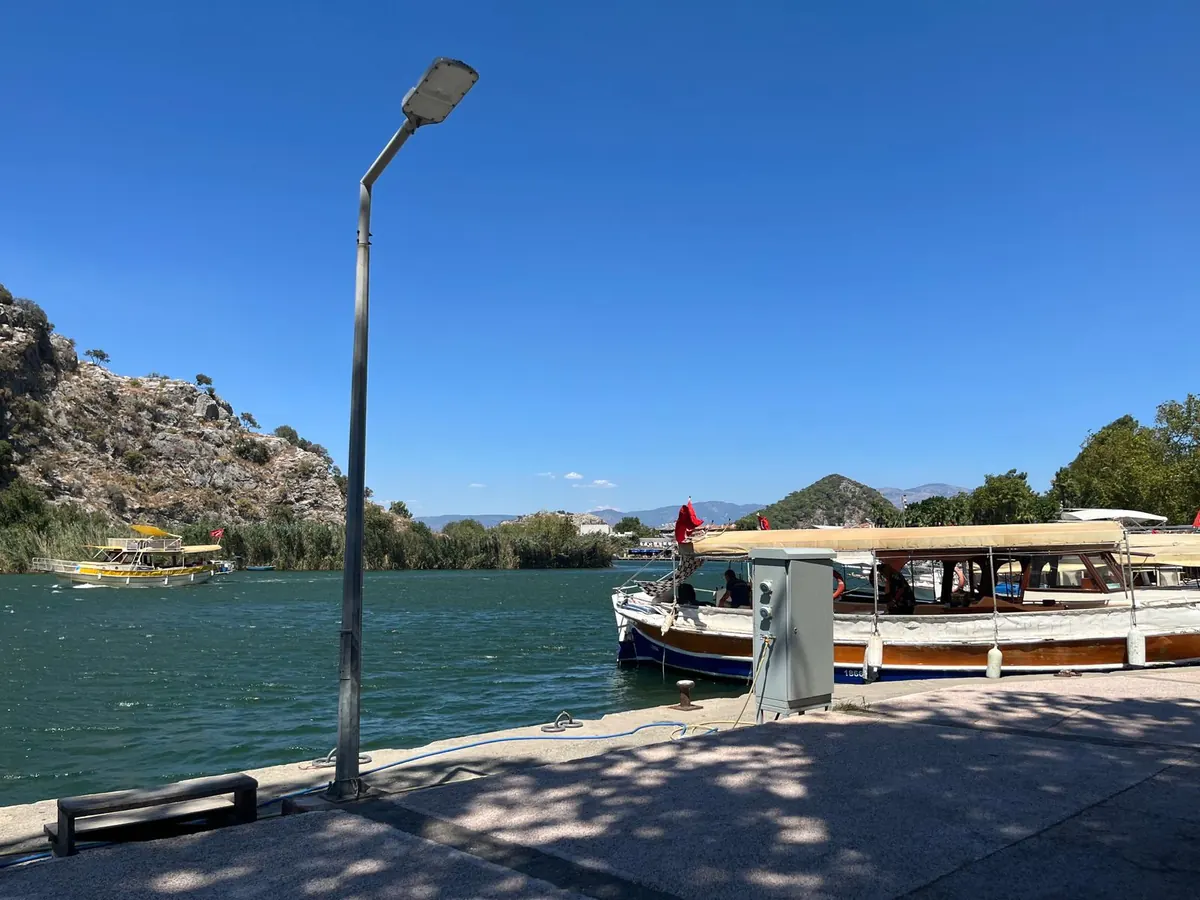
It is the version of Dalyan people picture: one line of restaurants along a green river, wooden fishing weirs across the channel, and a cliff of 2,400-year-old tombs looking back at the tables. Staying here means being inside that picture rather than walking down to it.
The advantages compound. The boat jetty is at the bottom of the town, so a 09:30 departure costs you a five-minute walk. The little ferry across to Kaunos leaves from the same water, and the Sunday market, the pharmacy and the dolmus stop for Ortaca and Koycegiz are all within a few hundred metres.
The evening is the real argument. The rock tombs are floodlit after dark, the good tables face them, and the walk back from dinner is flat and thirty seconds long. If anyone has a bad knee, or nobody wants to think about logistics for a week, this is the answer.
The weak side: a restaurant strip is loud until late, and sound carries over flat water. There is a mosque in the centre with a pre-dawn call to prayer. Riverside properties tend to be small, with thin walls and often no pool. Ask which way the room faces — a back room over a courtyard is a different night from a front room over the strip.
- Two to five minutes on foot to the boat jetty and the restaurants
- Flat walking in both directions, no hill at any point
- Kaunos ferry, market, pharmacy and dolmus stop within a few hundred metres
- Against it: strip noise until late, and a pre-dawn call to prayer
- Against it: often no pool, or a small shared one
What is the Gulpinar side like, and why is nearly every pool villa there?
The slope behind the town is residential Dalyan: quiet streets, walled gardens, citrus and pomegranate trees, and houses with room for a pool — which is exactly why the villas are there and not on the river.
What the extra walk buys is space and silence. A whole house rather than a room, a gate that shuts, a barbecue, a kitchen and a garden nobody else uses. The delta is a Specially Protected Area and building is low-rise throughout, so the view from most of these terraces is pine hills, roofs and the gap where the river runs.
It is cooler and darker at night than the strip, which matters in July and August when the air passes 35°C and the nights do not drop below the mid-twenties. Getting into your own water at two in the afternoon, and again after dinner with nobody around, is why people book villas here twice.
The weak side is the hill. Ten minutes downhill in the morning is twenty to twenty-five minutes uphill after dinner in August, and a family carrying a sleeping child will take a taxi instead. There is no reception, no daily housekeeping unless you arrange it, and nobody behind a desk when the pool pump stops. Ground-floor terraces are also where the mosquitoes are — this is a delta.
If the walk worries you but the pool is not negotiable, ask for a house on the lower edge of the slope rather than the top of it.
- A whole house: gate, kitchen, barbecue, garden and your own pool
- Quieter and cooler at night than the riverfront
- Ten to twenty minutes on foot to the river — uphill on the way back
- Against it: no reception, no daily housekeeping unless arranged
- Against it: mosquitoes on ground-floor terraces, and a taxi home on hot nights
Private pool villa or riverside boutique hotel: which suits your group?
Group size and the age of the youngest person decide this more reliably than budget does. Two adults on a short trip are usually better in a small hotel by the water; four adults or more, or anyone with children under about eight, in a villa.
The reason is hours rather than luxury. Small children need a pool within sight of a kitchen, a nap in the middle of the day and dinner earlier than a restaurant strip wants to serve it. A villa gives you all three without negotiating. A hotel room with a cot in it gives you an evening spent whispering in the dark from eight o’clock.
A couple on five nights has the opposite arithmetic. You will be on the water most of the day, eating out every night and using a pool for perhaps forty minutes in total. Paying for a house and garden to sleep in, then walking uphill afterwards, is effort spent on something you barely open.
Mixed groups settle it fastest. Six people in three hotel rooms have nowhere to sit together at ten at night; six people in one house have a terrace.
Neither option gives you a beach, so keep that out of the decision. Dalyan has no beach of its own; the sand is at Iztuzu, four and a half kilometres of it, half an hour down the river by shuttle boat.
- Two adults, short trip, out all day: riverside hotel
- Children under about eight: villa, for the pool and the kitchen
- Three couples, or grandparents plus a young family: villa, for the terrace
- Mobility problems or a bad knee: riverside, flat ground, no hill
- A week of doing very little: villa with a private pool, without question
What should you ask before you rent a villa in Dalyan with a private pool?
Four questions, and the first catches most of the disappointment: is the pool private, or shared between several houses in a complex? A listing that says "villa with pool" can legitimately mean one pool between six properties, and the photographs are usually cropped so you cannot tell.
Ask for a photograph taken from the pool looking back at the house. It shows the size, what overlooks it, how much is in shade at four in the afternoon, and whether the terrace is big enough to eat on. It also quietly settles the first question.
Second: how long is the walk into town, uphill, in the evening? Ten minutes and twenty-five minutes are different holidays. Third: air conditioning in every bedroom, not "in the villa" — a cooled living room and a hot back bedroom sleeps badly for whoever loses the draw, and July nights here stay in the mid-twenties.
Fourth, and the reason to book through anyone local at all: who answers the phone at eleven at night when the pool pump stops? A listing platform gives you a message box and a time zone. What you want is a person twelve minutes away who can arrive with a spanner in the morning.
- Is the pool private, or shared with other houses in a complex?
- A photo taken from the pool looking back at the house
- The walk into town, uphill, in the evening — in minutes
- Air conditioning in every bedroom, not just the living room
- Who you call at 11pm, and how far away they are
- Mosquito screens on the windows you will want open
What makes a good boutique hotel in Dalyan?
The small hotels here are judged on three things: which way the rooms face, whether there is any water on the property, and whether breakfast is served where you would want to sit. Everything else is decoration.
Orientation first. Rooms facing the river get the tombs, the boats and the light, and also the strip. Rooms facing the garden or the hill behind get quiet and lose the view. Neither is wrong, but nobody tells you which you booked unless you ask, and the difference is one floor and eight metres.
Water second. Small properties often have a plunge pool, a shaded courtyard, or nothing at all. In May and October that is fine. In August, with the air over 35°C, no water on the property means your afternoons happen somewhere else — workable if you planned them at Iztuzu or on a boat, grim if you had not.
Breakfast third, and it is why people return to a particular place rather than to Dalyan in general. A Turkish village breakfast is fifteen small plates and unlimited tea, it takes two hours, and eaten over the river at half past eight it is one of the best things in the town.
Two honest limits. Eight or twelve rooms means the good weeks fill early and a family of five may not fit at all. And boutique here means characterful rather than large: rooms are modest, lifts rare.
Does the month you visit change where you should stay?
Yes, and more than in most places, because Dalyan’s heat and its opening hours both swing hard with the calendar. The same house is a good idea in August and an unnecessary one in April.
May, June, September and early October are the easy weeks: warm sea, bearable air, everything open, both sides of town working. This is when a small riverside hotel with no pool is a perfectly good decision, because you will not need one.
July and August tilt the answer heavily towards a private pool. Temperatures regularly pass 35°C, the delta holds the heat, and the middle of the day becomes something to plan around. A pool you can use at any hour, without walking anywhere, is the difference between a good high-season week and an endurance test.
April and late October are a gamble that often pays off: green hills, cool evenings, a bracing sea. Unheated pools are cold enough then that most people use them once, for the photograph.
From November to March, Dalyan is a Turkish town in winter — beautiful, empty, wet, most tourist businesses shut, villa pools drained and covered. Stay somewhere heated and central, and check what is open before you commit.
How far ahead should you book, and what should you sort out first?
Book the accommodation first, then the airport transfer, then the boat days — in that order, because the house is the hardest thing to change and the boat is the easiest.
For July and August, villas with a genuinely private pool and space for six or more go months ahead. For May, June, September and early October, weeks rather than months is enough. Small hotels follow the same curve with less lead time, because a room is easier to shuffle than a house.
Say who is coming, not how many. Three couples need a different house from two adults and four children at the same headcount — bedrooms have to pair off, and the gap between one bathroom and three decides how the mornings go.
Then handle the first evening deliberately, because that is the one that goes wrong. Dalaman Airport is about 25 kilometres away, 25 to 30 minutes by road, and everybody lands tired. Arrange a stocked fridge rather than a supermarket run after a four-hour flight, and leave the boat trip for day two — eight hours in the sun on arrival day is a bad trade.
- High season: villas months ahead, hotels weeks ahead
- Tell whoever you book with who is coming, not just how many
- Airport transfer next — Dalaman is 25–30 minutes from either side of town
- A welcome shop beats a supermarket trip on the first night
- Boat trip on day two, not on arrival day