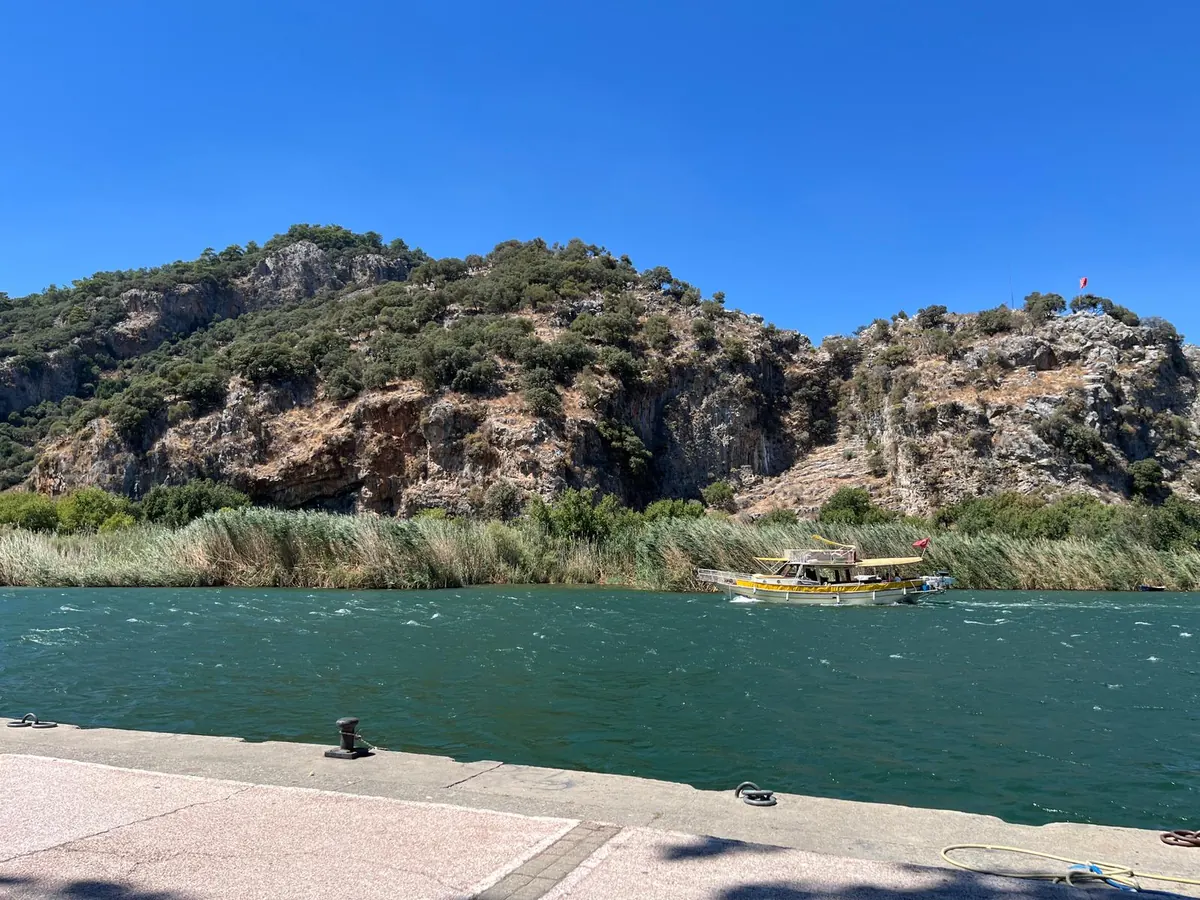
Why Dalyan asks a little more of visitors
Most visitors come in summer, which is exactly when the turtles are nesting and the delta is at its busiest. The same months that bring the tourism that supports the town also bring the most pressure on the animals and habitats that make it special.
The rules that exist here, from the night closure of the beach to the distance boats keep from turtles, are the reason Dalyan still has what it has. They were hard won; the story of how İztuzu was saved is worth knowing before you go.
None of this requires sacrifice. It mostly requires awareness.
On the river: distance, speed and turtles
Loggerhead turtles feed in the river and surface to breathe. A turtle at the surface is vulnerable to boats, especially propellers, and repeated disturbance affects how they feed and rest.
That is why responsible boats slow down in the stretches where turtles are common, keep their distance when one surfaces and never chase or circle an animal so passengers can get closer. As a passenger, you can help simply by not asking the crew to do otherwise.
Never feed turtles or fish. Feeding draws animals towards boats and people, changes their behaviour and can make them ill. Our turtle guide explains how to watch them well.
At İztuzu: the beach rules and why they exist
İztuzu is a nesting beach first and a tourist beach second. Its rules are set by the authorities and are the same for everyone:
- The beach closes to visitors overnight during the nesting season, when turtles come ashore to lay eggs and hatchlings head for the sea.
- Nests are marked. Keep well away from them and never dig near a marker.
- Umbrellas and sunbeds stay within their defined area, because poles driven into sand elsewhere can damage nests.
- No vehicles on the sand.
- Fill in any holes you dig and take down sandcastles, which can trap or block hatchlings.
- Take everything you brought back with you.
These are small things. On a beach used by thousands of people in a season, they add up to the difference between a working nesting beach and a lost one.
Choosing a boat that behaves well
As a visitor you have more influence than you might think, because you choose who to travel with. A few signs of a responsible operator:
- The crew slows down and keeps its distance when a turtle surfaces.
- Guests are told the basic rules, such as not feeding wildlife.
- Rubbish on board is collected and taken back, not left at stops.
- The boat keeps to normal speeds in the narrow channels rather than racing.
You can ask about any of this when you book. A good operator will be pleased you asked. For the other questions worth asking, see how to book a Dalyan boat trip.
Plastic and waste
A protected wetland and a busy summer season are a difficult combination for waste. Plastic that ends up in the river or on the beach does not disappear; it breaks into smaller pieces and stays in the system.
The simplest contribution is to bring back everything you take out, including small things like bottle caps and wrappers. If you smoke, take your cigarette ends with you rather than leaving them in the sand.
Where you can, carry a refillable bottle, and ask whether it can be refilled during the day. It will not solve the problem on its own, but it is one fewer bottle.
In the water and at the mud baths
Apply sun cream well before you swim so it has time to absorb, rather than straight before diving in. Less of it ends up in the water that way, and it protects you better.
At the Sultaniye mud baths, rinse off in the areas provided rather than in the lake. Do not use soap or shampoo in natural water anywhere in the delta.
When you swim near the boat or at İztuzu, give any turtle you see plenty of space. They generally avoid swimmers; the aim is simply not to follow them. For the practical side of swimming, see swimming on a Dalyan boat trip.
Spending money where it helps
Responsible travel is also about who benefits. Tourism is a large part of how people in Dalyan make a living, and it is also part of what makes protection politically possible: a beach worth more protected than developed stays protected.
Eating at local restaurants, buying from local producers and booking with people based in the town keep more of what you spend in Dalyan. The Muğla region, for instance, is well known for its pine honey, which makes a far better souvenir than something imported.
Booking direct with a local operator is part of the same picture, which we discuss in how to book a Dalyan boat trip.
Small habits that add up
- Keep voices down in the reed channels, where birds and terrapins are easily disturbed.
- Stay on the paths at Kaunos and do not climb on the ruins.
- Leave shells, stones and sand where they are.
- Ask before photographing people, especially those working on the river.
- Use a torch pointed at the ground, not the beach, if you are anywhere near İztuzu after dark.
None of this is difficult. Most of it is simply how you would want visitors to behave in a place you loved. The delta’s wildlife is covered in more detail in our guide to wildlife beyond the turtles.