Why a beach this good has no hotels
İztuzu is roughly four and a half kilometres of sand separating the Dalyan delta from the Mediterranean. It has warm, shallow water on the river side, open sea on the other, and a backdrop of hills that turn gold in the late afternoon. By any commercial logic it should be lined with resorts.
Instead it is one of the most important nesting beaches for loggerhead sea turtles in the Mediterranean, and it is protected. Building is restricted, the beach closes to visitors at night during the nesting season, and nests are marked and left alone.
Visitors often assume it was always like this. It was not. The protection is the result of a fight that took place less than forty years ago.
The hotel plan of the 1980s
In the mid-1980s, as tourism on the Turkish coast was starting to grow quickly, a large hotel development was planned for the area behind İztuzu. For investors the appeal was obvious: an empty, beautiful beach within reach of a new wave of international visitors.
Early work on the project began. For a short time it looked as though İztuzu would follow the path of so many other beaches along the coast, with the turtles quietly squeezed out by lights, noise, people on the sand at night and buildings on the dunes where they nest.
What nobody behind the project seems to have anticipated was that a beach this remote would have defenders with international reach.
A campaign that reached far beyond Dalyan
The best-known of those defenders was June Haimoff, a British woman who had settled in Dalyan and lived in a simple hut on İztuzu. Locals called her Kaptan June, a nickname that has outlived her. She had seen the turtles nesting on the beach and understood what a hotel would mean for them.
She was not alone. Local people who valued the beach, Turkish and foreign scientists and conservationists, and prominent public figures joined in, among them the British botanist and broadcaster David Bellamy. International conservation organisations took up the cause, and the story reached newspapers and television well beyond Türkiye.
The campaign worked because it turned a local planning question into an international one. Once İztuzu’s turtles had become a symbol, building a hotel on their nesting beach became far harder to justify.
The decision: building stopped, protection declared
In 1987 construction was halted. The following year, in 1988, the Turkish government declared the Köyceğiz–Dalyan area a Specially Protected Area, one of the country’s earliest environmental protection zones of its kind.
The designation covers far more than the beach. It includes Lake Köyceğiz, the river channel, the reed beds of the delta and the surrounding landscape. That wider protection is why the whole journey from the town to the sea still looks the way it does, rather than just the last stretch of sand.
It is worth pausing on how unusual that outcome was. Development pressure on this coast was enormous, and most places did not get a second chance.
What “Specially Protected Area” means for visitors today
For most visitors the protection is invisible, which is the point. But it shapes the day in several concrete ways:
- The beach closes to visitors overnight during the nesting season, so turtles can come ashore undisturbed.
- Nests are marked with small cages or markers. Stay well away from them and do not dig nearby.
- Umbrellas and sunbeds are kept to a defined strip, leaving the rest of the sand clear.
- Vehicles are not allowed on the sand.
- Boats in the channel are expected to keep their distance from turtles and not chase or crowd them.
These rules are set by the authorities, not by boat operators, and they are not negotiable. They are also the reason the beach still has turtles to protect.
Kaptan June’s legacy
June Haimoff stayed connected to İztuzu for the rest of her long life, and she remains a local figure decades after the campaign. The hut she lived in on the beach is still pointed out to visitors, and her name is attached to turtle conservation work in the area.
Her story is sometimes told as if one person saved the beach single-handedly. The more accurate version is that one determined person made enough noise that others joined her, and together they changed a government decision. That is arguably more encouraging.
Today the practical work of turtle protection at İztuzu includes nest monitoring and a rescue and rehabilitation centre for injured turtles. We cover what you can see there in our guide to spotting loggerheads in Dalyan.
Seeing İztuzu the way it was meant to be seen
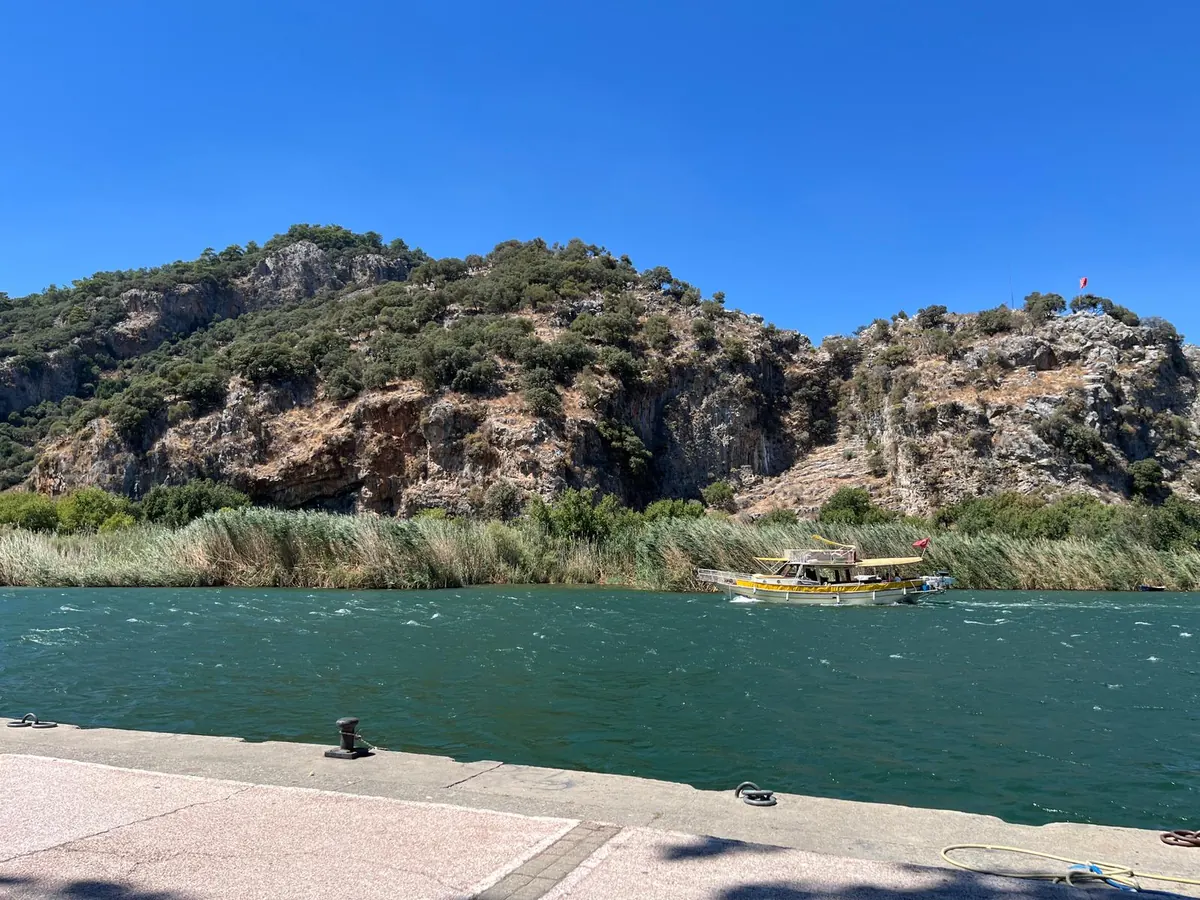
The classic way to arrive at İztuzu is by boat, down the river through the reed channels, past the fishing weirs and out to the sandbar. That route shows you the whole protected landscape in the right order, from lake to sea.
You can do it as the last stop of a full-day boat trip, where you get three to four hours on the beach, or on a direct boat to İztuzu if the beach is what you mainly want.
Either way, walk a little along the sand, away from the entrance. Within a few minutes the umbrellas are behind you and you are on the beach June Haimoff was trying to keep.
Your part in keeping it this way
Protection on paper only works if people respect it on the ground. The good news is that a visitor’s part is easy: follow the beach rules, take everything you bring back with you, and keep distance from turtles in the water.
It also helps to choose operators who take the rules seriously. A boat that races up to a surfacing turtle so everyone can get a photograph is not doing anyone any favours, least of all the turtle.
We put together a fuller guide to visiting Dalyan responsibly, covering the beach, the river and the town.